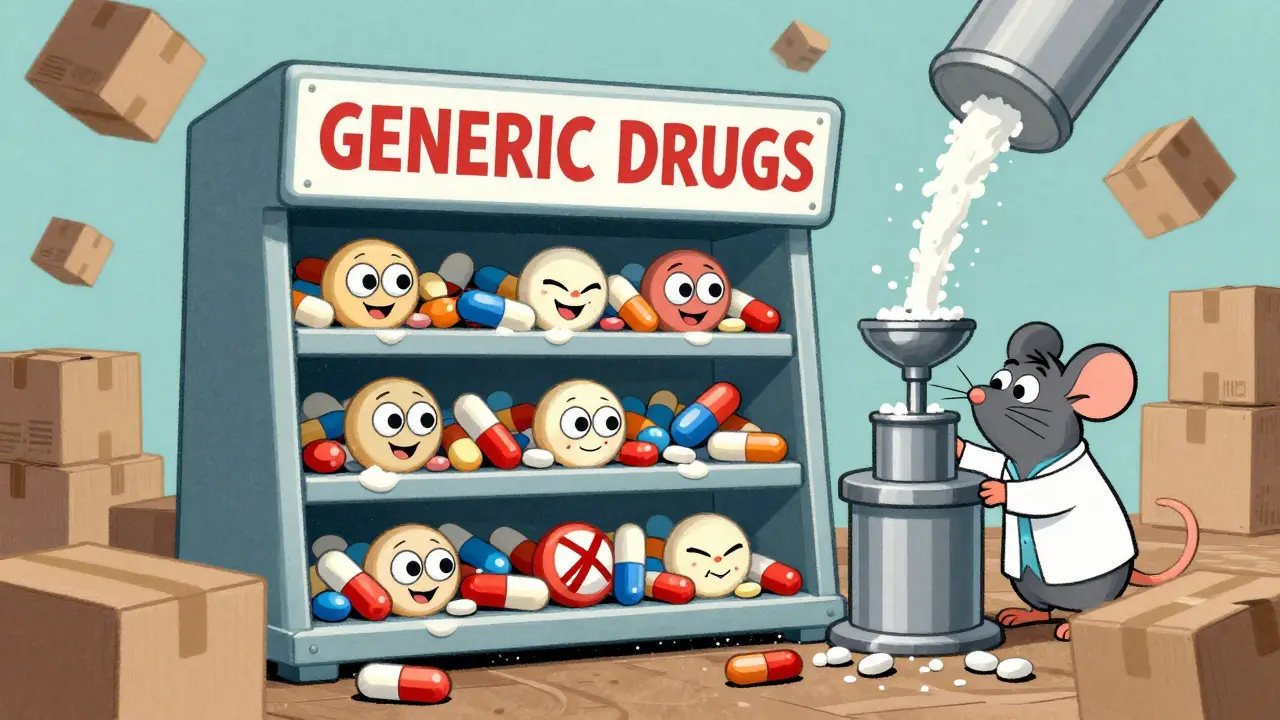
Every year, millions of people take generic drugs because they’re affordable and effective. But what if the pill in your bottle isn’t what it claims to be? Fake generic drugs are a growing global crisis - not just a problem in faraway countries, but one that sneaks into pharmacies and online stores everywhere. These counterfeit medicines look real. They have the right color, shape, and packaging. But inside? They might have no active ingredient, too little, or worse - toxic chemicals. And they’re getting harder to spot.
How fake drugs are made
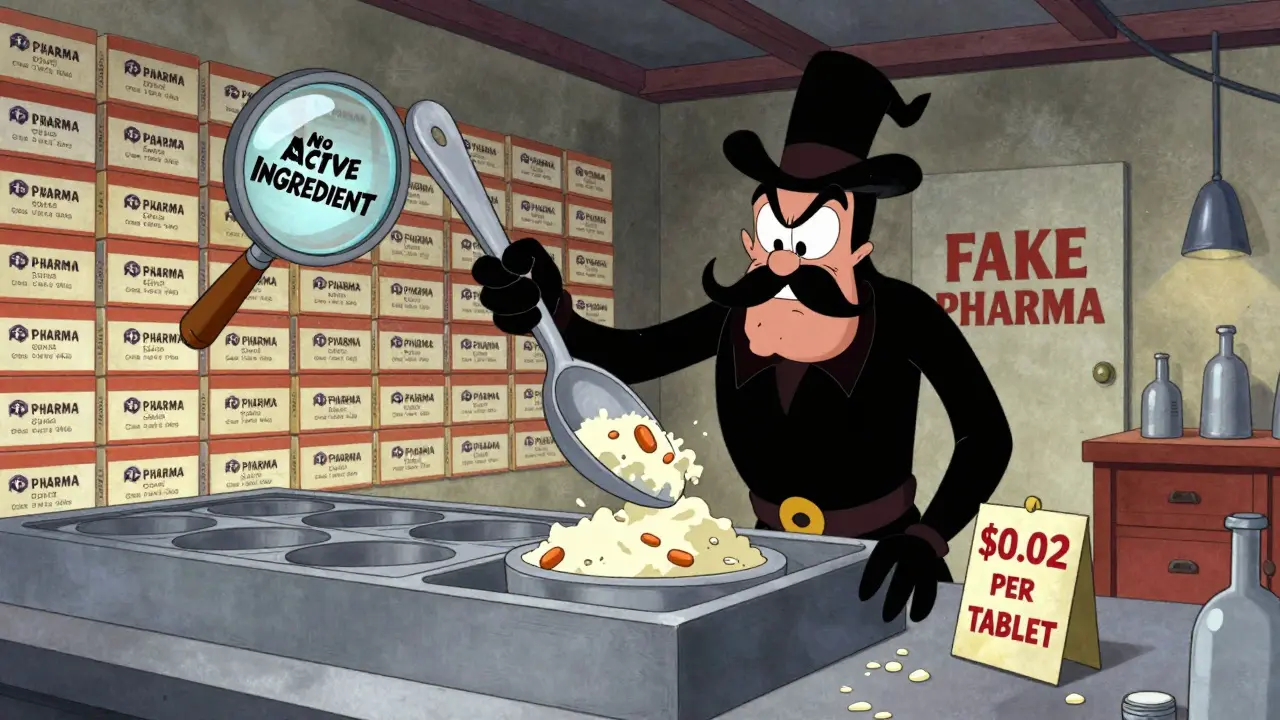
Counterfeit generic drugs don’t appear out of nowhere. They’re made in hidden labs, often in places with weak drug regulations. Think small factories in Southeast Asia, Eastern Europe, or parts of Africa. These aren’t high-tech labs with scientists in white coats. They’re basements, garages, or warehouses with basic equipment: mixing bowls, tablet presses, and printers. The goal? Copy the real thing as closely as possible - and save every penny.Take a common generic blood pressure pill, like losartan. The real version costs $0.10 per tablet. A fake one? It might cost $0.02 to make. The manufacturer skips the real active ingredient and uses cheap fillers - chalk, flour, or even sawdust. Sometimes they add a tiny bit of the real drug to trick tests. Other times, they use harmful substitutes like industrial chemicals. One 2021 study found that 77% of fake drugs seized were oral tablets - the most common form - and many targeted high-demand generics like antibiotics, antimalarials, and heart meds.
And the packaging? It’s scary accurate. Using commercial-grade printers and real packaging templates, counterfeiters replicate logos, fonts, and even batch numbers. A 2023 analysis by TrueMed Inc. found that 95% of fake drug packages look identical to the real thing under normal light. Even pharmacists can’t tell the difference without lab tools.
The three main ways fake drugs get into the supply chain
Counterfeit drugs don’t just show up on your pharmacy shelf. They slip in through cracks in the system. Here’s how:
- Parallel importation - This happens when drugs are bought legally in one country, then resold in another where regulations are looser. A batch of genuine pills might be mixed with fake ones at a warehouse. The fake ones look identical, so no one notices until patients stop responding to treatment.
- Grey market sales - Unauthorized distributors buy drugs from wholesalers, then sell them to pharmacies without proper documentation. These sellers often don’t verify the source. In 2022, the National Association of Boards of Pharmacy found that 95% of online pharmacies operating without licenses were selling fake drugs. Many of these sites look like real pharmacies - they even have fake certifications.
- Online pharmacies - This is the biggest loophole. People search for cheap meds online, click a link, and get a box in the mail. No prescription needed. No verification. In 2023, a Reddit user named u/PharmaWatcher posted about buying counterfeit Lipitor. The pills had the wrong scoring, a slightly different color, and dissolved too fast in water - a clear sign they weren’t real. He sent them to a lab. They contained no atorvastatin at all.
These aren’t rare cases. The U.S. Pharmacopeia’s database recorded over 1,200 incidents of fake or substandard drugs between 2013 and 2023. The top three targets? Cardiovascular drugs (28.7%), antibiotics (22.4%), and antimalarials (18.9%).
Why generics are the main target
Why not go after brand-name drugs like Viagra or Humira? Because they’re harder to copy legally. Brand-name drugs are protected by patents and monitored closely. Generics? They’re everywhere. The global generic drug market hit $438.7 billion in 2022. That’s a huge target. Companies making generics compete on price. To cut costs, some legitimate manufacturers cut corners. Counterfeiters? They cut everything.
Plus, generics are often produced in multiple countries. One batch might come from India, another from China, another from Brazil. Each step adds a chance for fraud. A 2008 case in the U.S. showed how dangerous this can be: contaminated heparin - a blood thinner - came from a Chinese supplier. It had been adulterated with a chemical that caused 149 deaths. That wasn’t a fake drug. It was a real drug made with a fake ingredient. The same risk exists today.
How detection fails
You’d think drug regulators would catch these. But they don’t. Why? Because the system is broken.
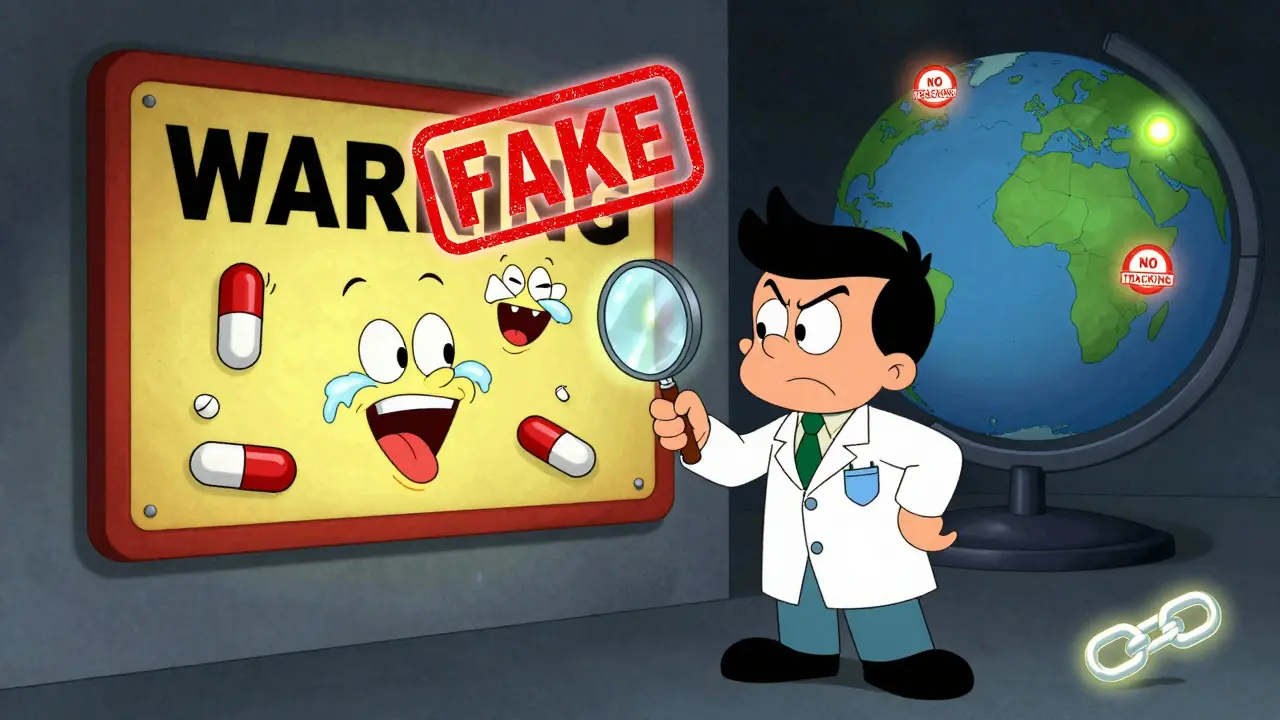
Only 40% of countries have track-and-trace systems that follow drugs from factory to pharmacy. Of those, only 22 countries - out of 194 WHO member states - have fully working systems as of early 2023. That means most drugs move through the supply chain without a digital trail. No barcode. No serial number. No way to know if a batch was stolen, diverted, or swapped.
Even when systems exist, they’re not linked. A drug might be tracked in the U.S., but not in Nigeria. A wholesaler in Germany might have a scanner, but the pharmacy in Guatemala doesn’t. And counterfeiters know this. They ship drugs through countries with weak oversight, then repackage them for markets with stricter rules.
Testing is another problem. Labs can detect fake drugs - but only if they test. Most pharmacies don’t have the tools or budget. A 2022 survey of 1,200 pharmacists across 45 countries found that 68% had seen suspected counterfeit drugs. But 32% couldn’t tell the difference between real and fake without lab equipment.
What’s being done - and what’s not working
Some progress is being made. The EU’s Falsified Medicines Directive, rolled out in 2019, forced pharmacies to scan every package. Since then, counterfeit penetration in Europe has dropped by 18%. Companies like MediLedger are testing blockchain systems that track each pill from manufacturer to patient. In trials, they caught 97.3% of supply chain anomalies.
But these solutions cost money. Adding a hologram or DNA tag to a pill costs $0.02 to $0.05 per unit. For a generic drug that sells for $0.10, that’s a 50% cost increase. Most manufacturers won’t pay it. And in low-income countries, governments can’t afford it either.
Pharmaceutical companies like Pfizer have spent millions on anti-counterfeiting programs. Since 2004, they’ve stopped over 302 million fake doses from reaching patients. But they can’t do it alone. They need cooperation from customs, police, and online platforms - and that’s slow.
Meanwhile, criminals are adapting. In February 2023, Europol seized cancer drugs with AI-generated holograms. The fakes were so perfect, even trained inspectors missed them. AI can now design packaging that mimics every detail - down to the slight curve of a logo or the exact shade of blue on a blister pack.
What you can do
You can’t stop counterfeits alone. But you can protect yourself.
- Buy from licensed pharmacies only. If it’s not a physical store or a verified online pharmacy (like those listed by NABP), don’t trust it.
- Check the packaging. Compare it to a previous bottle. Look for spelling errors, mismatched fonts, or odd colors. If the tablets look different - smaller, smoother, or oddly shaped - ask your pharmacist.
- Don’t buy from social media or Google ads. Fake pharmacies use targeted ads. If the price seems too good to be true, it is.
- Report suspicious drugs. If something feels off, tell your pharmacist or local health authority. One report can trigger an investigation.
And if you’re taking life-saving meds - like insulin, antivirals, or heart drugs - never skip your refill. Going without can be deadly. Counterfeit drugs might not kill you right away. But they’ll make your condition worse. And that’s just as dangerous.
What’s next
The OECD predicts counterfeit drugs could make up 5-7% of global medicine sales by 2030 if nothing changes. That’s not a guess - it’s a projection based on current trends. The problem is growing faster than the solutions.
What’s needed? Global standards. Better tracking. Real penalties for violators. And more transparency. Right now, the system is a patchwork. A drug might be safe in one country, fake in another. A pharmacy might be licensed in one city, but illegal in the next.
Until we fix that, fake generics will keep slipping through. And people will keep getting sick - not because their disease is untreatable, but because the medicine they trusted never worked at all.
 Generic Drug Prices: Why Americans Pay Less Than Europeans
 How to Handle Prescription Transfers Between Countries: A Practical Guide for Travelers
 Esophageal Cancer Risk from Chronic GERD: Key Red Flags You Can't Ignore
 Terramycin vs Alternative Antibiotics: Tetracycline Comparison Guide
 Transform Your Health with Gossypol – The Game-Changing Supplement
Ellen Spiers
February 21, 2026 AT 21:17The structural vulnerabilities in the global pharmaceutical supply chain are not merely operational inefficiencies-they are systemic failures of governance, oversight, and economic incentivization. The absence of harmonized track-and-trace protocols across WHO member states constitutes a regulatory arbitrage opportunity for bad actors. The fact that only 22 countries possess fully functional systems underscores a profound asymmetry in public health infrastructure. Moreover, the economic disincentive for manufacturers to adopt anti-counterfeiting measures-such as holographic serialization or DNA tagging-at a marginal cost of $0.02–$0.05 per unit reveals a market failure where profit maximization supersedes patient safety. This is not a technical problem. It is a political one.
Marie Crick
February 22, 2026 AT 14:43This is why people die.
Maddi Barnes
February 23, 2026 AT 01:07Okay, I need to say this with love but also with full-on eye-roll: we keep acting like this is some new crisis, but we’ve been here before. Remember the heparin scandal? The fake insulin in Mexico? The counterfeit HIV meds in Africa? We keep having the same conversation because we keep treating this like a ‘supply chain issue’ instead of a global inequality issue. The reason these fakes thrive is because real meds are unaffordable in 80% of the world. People aren’t buying fake pills because they’re dumb-they’re buying them because they have no choice. And while the EU scans every package, the average person in Lagos or Manila is scrolling through Instagram ads for ‘discounted’ metformin because their clinic ran out. We need to fix the pricing, not just the packaging. Also, 🤦♀️
Benjamin Fox
February 24, 2026 AT 05:47China and India are running the show here and nobody’s doing anything. We let them make our meds and now we’re paying the price. The FDA is asleep at the wheel and our politicians are too busy tweeting to care. This is why America needs to bring manufacturing home. No more outsourcing life-saving drugs to third-world labs. If you want real medicine, buy American. Period. 💪🇺🇸
Jonathan Rutter
February 25, 2026 AT 10:01You know what’s worse than fake pills? The fact that we’re all so numb to this now. I used to work in a pharmacy. I saw people come in with prescriptions for insulin, heart meds, antibiotics-and they’d get the same box, same color, same label, but the pills were just… wrong. Smelled like plastic. Dissolved too fast. One guy asked me if it was ‘the new formula.’ I had to tell him his blood pressure was spiking because the active ingredient was 12% of what it should be. He didn’t even know he was dying slowly. And now we have AI generating fake holograms? We’re not fighting criminals anymore-we’re fighting a machine that knows how to mimic trust. We’ve turned medicine into a commodity and now we’re reaping what we sowed. No one’s accountable. No one’s punished. And the people who pay? They’re just… gone.
Jana Eiffel
February 26, 2026 AT 18:46The philosophical underpinning of this crisis lies in the ontological shift from medicine as a public good to medicine as a market product. When therapeutic efficacy is subordinated to cost-efficiency, the epistemic authority of pharmaceutical regulation becomes contingent upon economic rather than ethical imperatives. The absence of global standardization is not merely logistical-it is epistemological. We no longer share a common epistemic framework for verifying therapeutic integrity. The counterfeit pill, therefore, is not merely a physical object, but a symbol of the collapse of collective trust in institutional knowledge. The solution, then, cannot be technological alone; it must be reconstructive, requiring a renewed social contract around the sanctity of health as a universal right.
John Cena
February 28, 2026 AT 13:49Really appreciate this deep dive. I’ve been thinking about this since my grandma had to switch to a cheaper generic for her blood pressure and started feeling dizzy. We assumed it was just aging-but turns out, the batch she got had 3% of the active ingredient. She’s fine now, got it from a verified pharmacy. But it’s scary how easy it is to miss. I’m not saying don’t use generics-I use them. But I check the lot number now. I ask for the manufacturer. I avoid anything that feels off. Small steps, but they matter.
aine power
March 1, 2026 AT 09:03How quaint. The ‘buy from licensed pharmacies’ advice is so 2018. The real solution is to ban all generic manufacturing outside OECD nations. End of story.