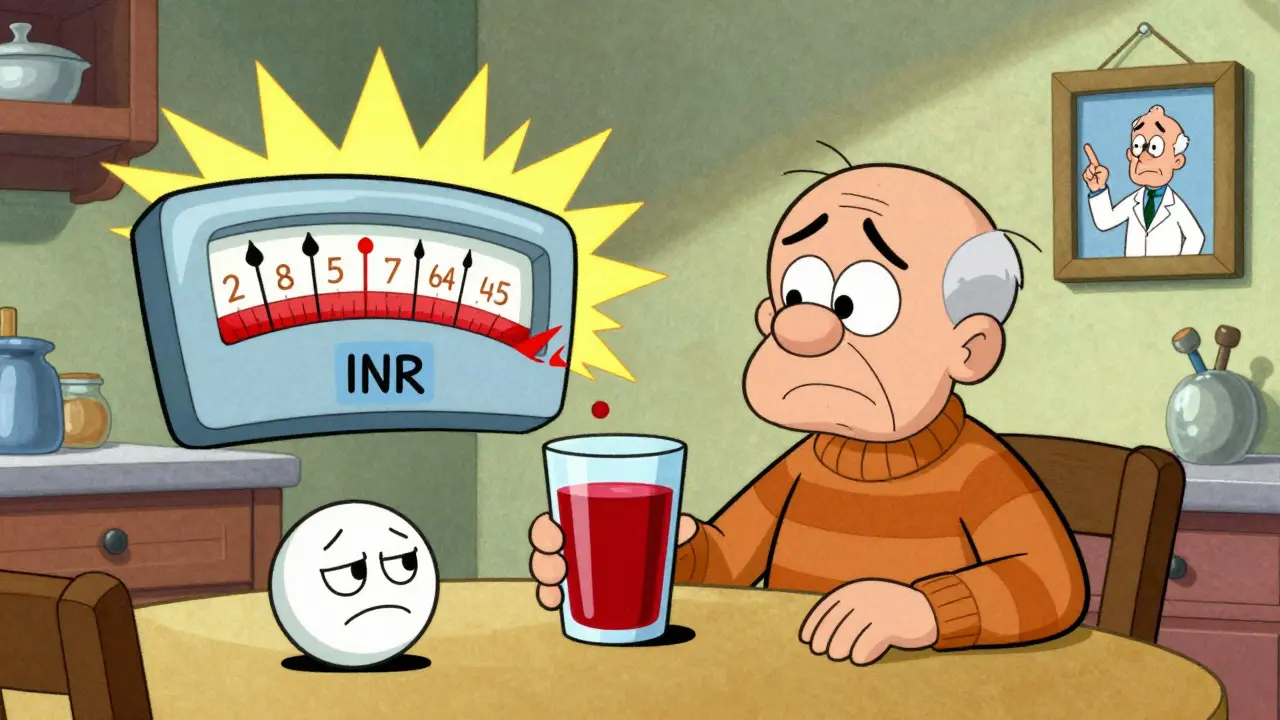
If you're taking warfarin, a common blood thinner, and you love cranberry juice or take cranberry supplements for urinary health, you need to pay attention. This isn't just a theoretical concern - it's a real, documented risk that can lead to dangerous bleeding. People have ended up in the hospital because their INR spiked after drinking a daily glass of cranberry juice. And it doesn’t take much: some cases show serious effects after just 150 mL a day.
Why Cranberry and Warfarin Don’t Mix
Warfarin works by slowing down blood clotting. It’s prescribed for conditions like atrial fibrillation, deep vein thrombosis, and after heart valve replacements. But it’s tricky. Too little, and you risk a clot. Too much, and you risk bleeding - internally, in your brain, your gut, or even under your skin. That’s why doctors monitor your INR (International Normalized Ratio), a number that tells them how long your blood takes to clot. The target range is usually between 2.0 and 3.0. Cranberry products - juice, capsules, extracts, even flavored drinks - can push that number dangerously high. The reason? Cranberries contain compounds called flavonoids, especially quercetin, that interfere with how your liver breaks down warfarin. Specifically, they block an enzyme called CYP2C9. This enzyme is responsible for clearing the most active form of warfarin (S-warfarin) from your body. When it’s blocked, warfarin builds up. That means your blood thins more than intended. This isn’t speculation. Since 2003, dozens of case reports have shown patients with stable warfarin doses suddenly developing INRs of 4.5, 6.5, even 12.0 after starting cranberry products. One 78-year-old man in Los Angeles saw his INR jump from a steady 2.8 to 6.45 after drinking half a gallon of cranberry-apple juice every week. He didn’t feel sick until he started bleeding internally. That’s how silent this can be.What Counts as a Cranberry Product?
It’s not just the bright red juice in the grocery aisle. Anything made from cranberries can be a problem:- Cranberry juice (even if it’s 25% juice blended with apple or grape)
- Cranberry capsules or tablets sold as dietary supplements
- Cranberry extracts or concentrated powders
- Cranberry-flavored sodas, teas, or energy drinks
- Cranberry sauce or dried cranberries (less risk, but still possible)
The Evidence Isn’t Perfect - But the Risk Is Real
You might hear conflicting advice. Some small studies say cranberry doesn’t affect INR. That’s true - but those studies often use low doses, short durations, or healthy volunteers. Real patients aren’t healthy volunteers. They’re older, often on multiple medications, and may have genetic differences that make them more sensitive. The real-world data tells a different story. In the r/anticoagulants Reddit community, multiple users reported INR spikes after starting cranberry juice. One wrote: "My INR went from 2.4 to 4.1 in one week. My hematologist told me to stop immediately." Another said: "I took cranberry pills for five years with no issues - but I got checked every two weeks." That’s the key: consistency matters. But even then, it’s not worth the gamble. The American College of Chest Physicians says if you’re going to consume cranberry products at all, you need INR checks within 3-5 days of starting - and weekly after that. But even that’s not foolproof. The risk isn’t just about how much you take - it’s about how your body reacts. Some people are genetically wired to be extra sensitive to this interaction.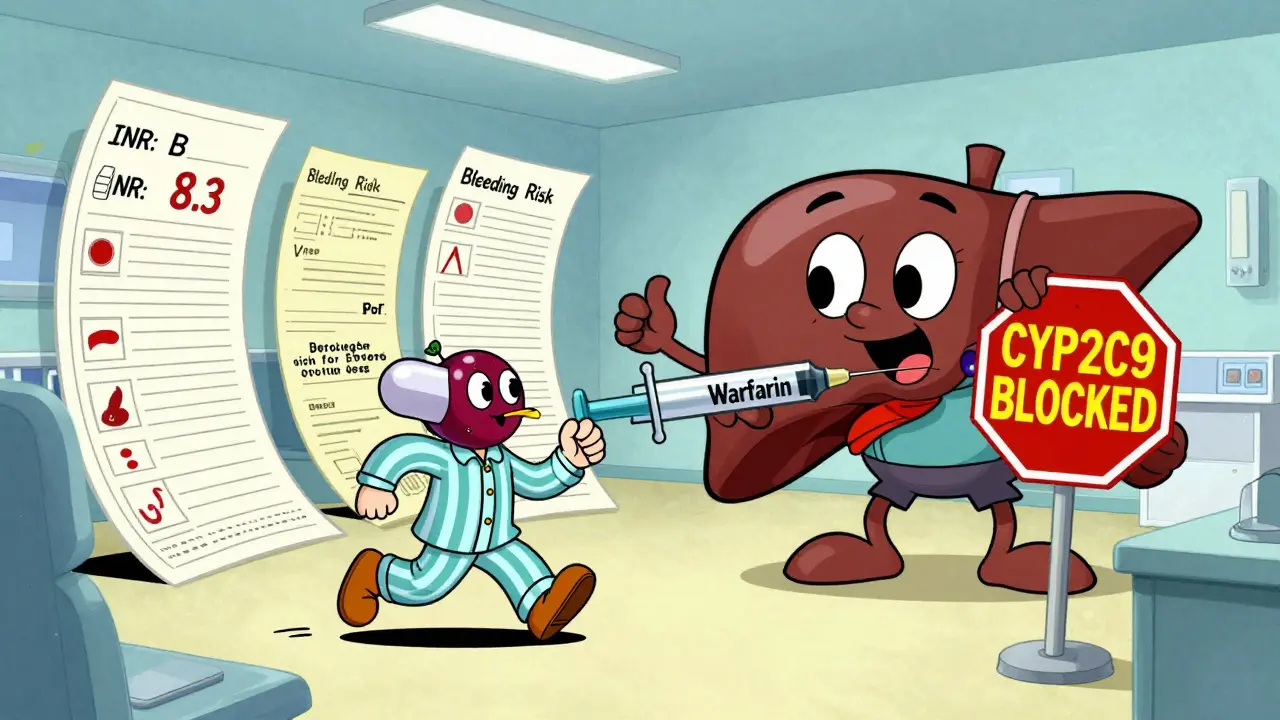
Who’s Most at Risk?
Not everyone who drinks cranberry juice while on warfarin will have a problem. But some people are far more vulnerable:- People with CYP2C9 gene variants (like *CYP2C9*2 or *CYP2C9*3) - these slow down warfarin metabolism even without cranberries
- Older adults - metabolism slows with age, and they’re more likely to be on warfarin
- Those with kidney or liver problems - these organs help clear both warfarin and cranberry compounds
- People taking other medications that also affect CYP2C9 - like some antibiotics or anti-seizure drugs
What Should You Do?
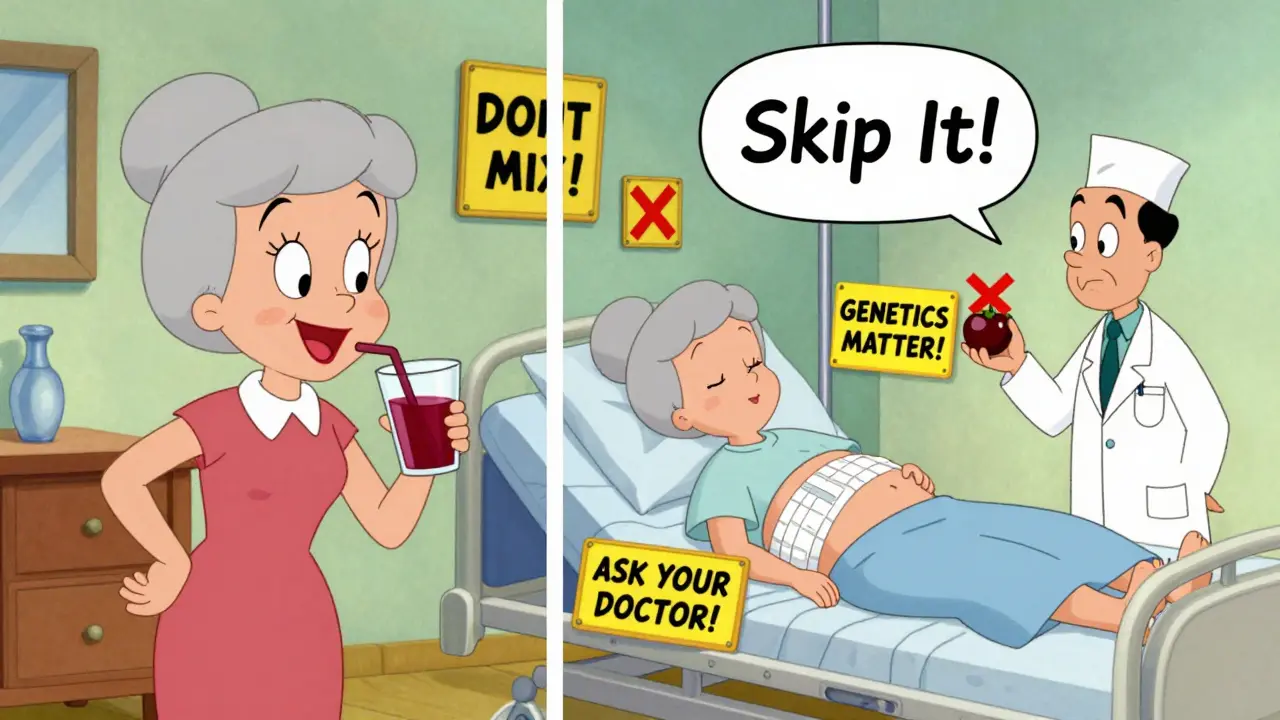
If you’re on warfarin, here’s what experts recommend:- Avoid cranberry products entirely. This is the safest choice. The American Heart Association says even occasional use can cause unpredictable spikes.
- If you’ve been drinking cranberry juice regularly, don’t stop suddenly without talking to your doctor. Abrupt changes can also affect your INR.
- If you absolutely must use cranberry (say, for recurrent UTIs), tell your doctor. Get your INR checked within a week of starting, and then weekly until it stabilizes.
- Ask your doctor about alternatives. For UTI prevention, methenamine hippurate or low-dose antibiotics are safer options than cranberry.
- Read labels. Many "fruit drinks" and "smoothies" contain cranberry extract - even if it’s not the main flavor.
 Warfarin and Vitamin K: Managing Dietary Consistency for INR Control
 Unlock Your Body's Natural Energy with Ribose: The Revolutionary Dietary Supplement
 Castoreum: The Ancient Secret to Boosting Your Immune System and Overall Health
 How Budesonide Formoterol Helps Manage Chronic Obstructive Pulmonary Disease (COPD)
 Buy Cheap Generic Atenolol Online - Safe Tips & Best Prices
Matt Davies
December 19, 2025 AT 15:12This is one of those posts that makes you pause and actually thank your doctor for being so thorough.
Warfarin’s already a tightrope walk-adding cranberry juice is like juggling chainsaws while blindfolded.
God bless the people who document these risks so clearly.
Stay safe out there, folks.
Laura Hamill
December 20, 2025 AT 00:04cranberry juice is just nature’s way of testing if you’re dumb enough to ignore warnings
and the answer is always yes
because people are idiots
and now i’m mad at my cousin who still drinks it
she says ‘but i’ve never had a problem’
yeah well neither did the guy who jumped off the bridge until he hit the ground
Alana Koerts
December 20, 2025 AT 01:34why are we still talking about this like it’s new?
the FDA warned about this in 2005
the Merck Manual says avoid it
and yet people still act surprised when their INR spikes
you can’t be this lazy and expect to live long
pascal pantel
December 21, 2025 AT 04:11the pharmacokinetic interaction is well-documented: CYP2C9 inhibition → reduced S-warfarin clearance → supratherapeutic anticoagulation → increased bleeding risk.
the fact that laypeople still treat this as a ‘myth’ is a failure of public health literacy.
also, ‘natural’ doesn’t mean ‘non-pharmacologic’-cranberry is a bioactive compound delivery system.
stop romanticizing botanicals.
Dikshita Mehta
December 21, 2025 AT 20:59if you’re on warfarin and love cranberries, try switching to blueberries or pomegranate-same antioxidant punch, zero interaction risk.
and if you’re worried about UTIs, talk to your doctor about methenamine-it’s safe, cheap, and doesn’t make your INR climb like a ladder.
you don’t have to give up flavor, just the danger.
you’ve got this ❤️
Henry Marcus
December 22, 2025 AT 19:22EVERYONE KNOWS THE GOVERNMENT AND PHARMA ARE HIDING THE TRUTH ABOUT CRANBERRIES!!
THEY’RE AFRAID OF THE NATURAL CURE!!
WHY DO YOU THINK THEY MADE WARFARIN IN THE FIRST PLACE??
TO KEEP PEOPLE DEPENDENT ON CHEMICALS!!
CRANBERRY JUICE IS A 5000-YEAR-OLD ANCIENT REMEDY!!
THEY TOOK IT FROM THE NATIVE AMERICANS AND TURNED IT INTO A ‘DANGER’ TO MAKE MONEY!!
MY NEIGHBOR’S DOG DRANK CRANBERRY JUICE FOR 12 YEARS AND NEVER HAD A BLOOD CLOT!!
THEY’RE LYING TO YOU!!
THEY’RE LYING TO YOU!!
THEY’RE LYING TO YOU!!
THEY’RE LYING TO YOU!!
THEY’RE LYING TO YOU!!
THEY’RE LYING TO YOU!!
THEY’RE LYING TO YOU!!
THEY’RE LYING TO YOU!!
THEY’RE LYING TO YOU!!
mark shortus
December 23, 2025 AT 21:37ok so i just got back from the er
my inr was 7.8
and guess what i’d been drinking every morning for 3 weeks?
cranberry-apple juice
because it was ‘lighter’
and my wife said ‘it’s just juice’
and now i’m here
with needles in my arm
and a nurse yelling at me
and i’m crying
because i didn’t read the label
and now i’m scared to drink anything ever again
and i just want to go home
and i’m so sorry
please don’t be me
Aboobakar Muhammedali
December 24, 2025 AT 09:58i used to take cranberry pills for my bladder
for years
no problems
then one day my legs felt heavy
and i had a bruise i didn’t remember
my doctor asked me about cranberry
i said ‘oh that’
he said ‘stop’
i did
inr dropped in 5 days
no drama
no hospital
just quiet relief
you don’t need to be a hero
just listen
and live
Meenakshi Jaiswal
December 24, 2025 AT 17:27if you’re on warfarin, your body is already doing a lot.
your liver is working overtime.
your kidneys are helping out.
your brain is trying to remember to take your pill at the same time every day.
adding cranberry is like asking your car to drive 120 mph while towing a trailer and you’re also trying to fix the radio.
it’s not that it’s impossible-it’s that it’s asking too much.
your body deserves a break.
choose peace over taste.
you’re worth more than a glass of juice.
and if you’re struggling with the switch?
talk to your pharmacist.
they’re not just pill dispensers-they’re your allies.
you’re not alone in this.
we’ve all got our own battles.
but this one? it’s winnable.
and you’re already halfway there.
Gloria Parraz
December 25, 2025 AT 14:14my dad had a stroke last year
they put him on warfarin
he loved cranberry juice
he said it was ‘his little treat’
i begged him to stop
he said ‘i’ve had it for 40 years’
he didn’t listen
two months later
he bled into his brain
he never woke up
so if you’re thinking ‘it’s just juice’
just think of someone you love
and then think again
please
Takeysha Turnquest
December 26, 2025 AT 18:54we are all just temporary vessels of blood and fear
warfarin reminds us that control is an illusion
cranberry is the whisper that says ‘you are not safe’
and yet we drink it anyway
because to live is to flirt with the unknown
and maybe that’s the real tragedy
not the INR
but the fact that we still choose the juice
even when we know
even when we know
even when we know