Anticholinergic Risk Calculator
This tool estimates your risk of urinary retention when taking anticholinergics if you have prostate enlargement (BPH). Based on guidelines from the American Urological Association and FDA data.
Men with an enlarged prostate are often told to take anticholinergics for an overactive bladder. It sounds simple: less urgency, fewer leaks. But for many, this solution becomes a crisis. Anticholinergics don’t just help with bladder spasms-they can shut down the bladder’s ability to empty entirely, especially when the prostate is already blocking the way. This isn’t a rare side effect. It’s a well-documented, dangerous interaction that sends thousands to the ER every year.
How Anticholinergics Work (and Why They’re Risky for Prostate Patients)
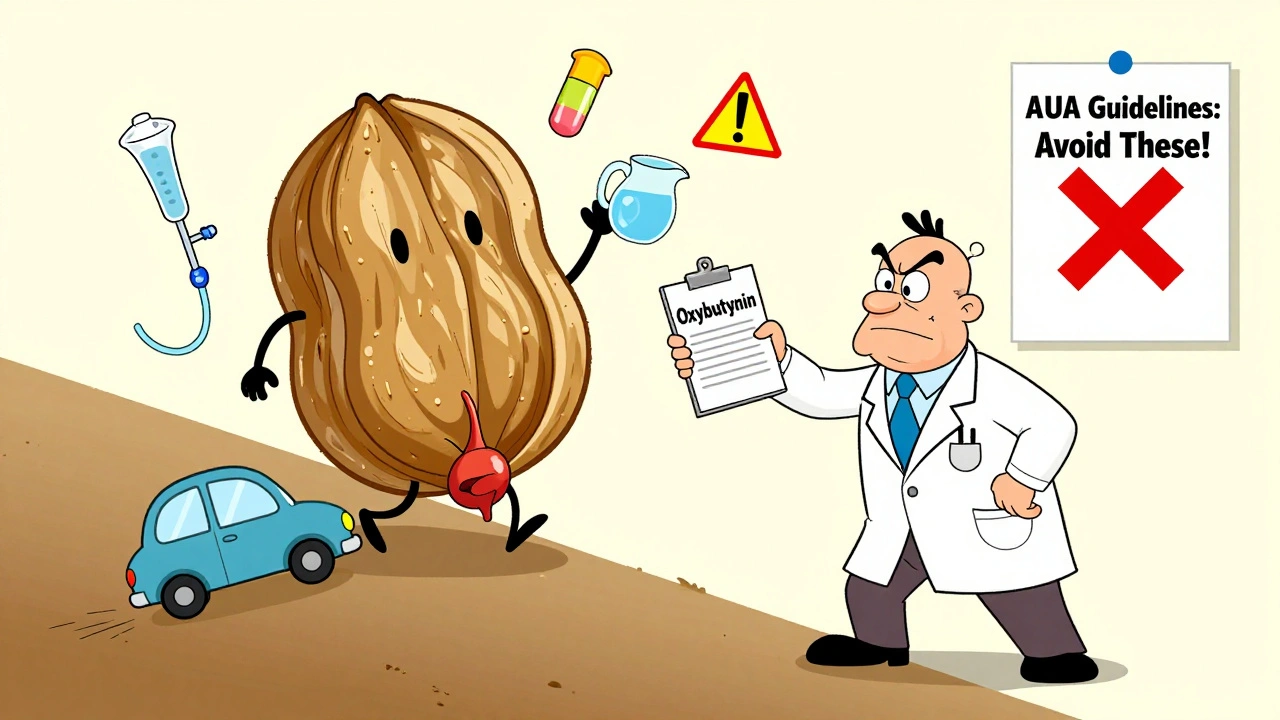
Anticholinergics like oxybutynin, solifenacin, and tolterodine work by blocking acetylcholine, a chemical that tells the bladder muscle to contract. For someone with an overactive bladder, this can reduce sudden urges and incontinence. But if your prostate is enlarged-common in men over 50-that same bladder muscle is already fighting hard just to push urine past the blockage. Adding an anticholinergic is like putting a brake on a car that’s barely climbing a hill.
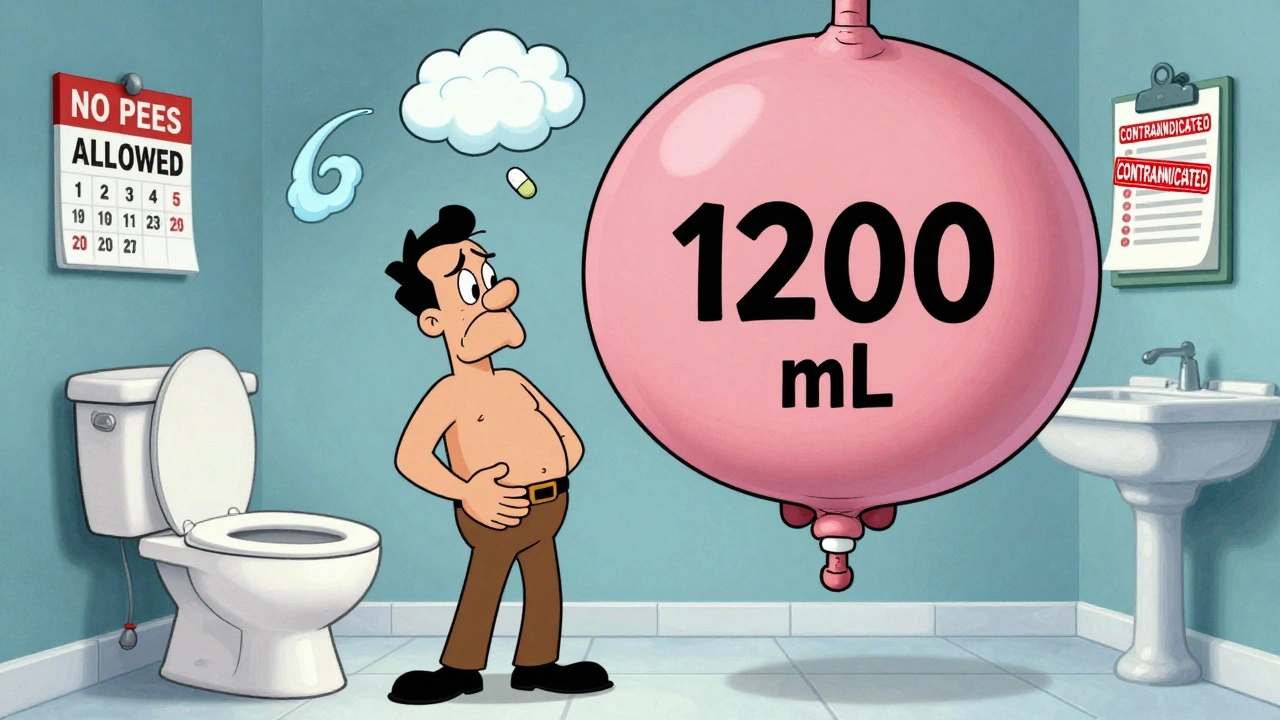
The result? The bladder can’t contract strongly enough to overcome the obstruction. Urine builds up. The bladder stretches. And if it fills too much, you can’t pee at all. That’s urinary retention. Acute retention means you’re completely unable to void, with a bladder holding over a liter of urine. It’s painful. It’s urgent. And it often needs a catheter to fix.
The Numbers Don’t Lie
Studies show men with benign prostatic hyperplasia (BPH) who take anticholinergics are 2.3 times more likely to develop acute urinary retention than those who don’t. In one large analysis, 8-15% of patients on these drugs reported trouble urinating. For men with moderate to severe BPH, that number jumps higher. The FDA’s adverse event database recorded over 1,200 cases of urinary retention linked to anticholinergics between 2018 and 2022. Sixty-three percent of those cases were in men over 65 with diagnosed prostate enlargement.
Real-world stories back this up. On patient forums, men describe waking up unable to pee, rushing to the ER, and being catheterized after hours of pain. One man reported his bladder held 1,200 ml-more than a liter-after starting Detrol. Another said he’d been on anticholinergics for months, thinking they were helping, until he suddenly couldn’t urinate at all. These aren’t outliers. They’re predictable outcomes.
Guidelines Say: Avoid Them
The American Urological Association (AUA) has been clear since 2018: don’t use anticholinergics in men with significant prostate enlargement. Their guidelines say avoid them if your AUA symptom score is over 20 or your prostate is larger than 30 grams. The American Geriatrics Society’s Beers Criteria, updated in 2019, lists anticholinergics as potentially inappropriate for older adults with urinary retention or BPH. Yet, a 2020 study found that 40% of nursing home residents with these conditions were still being prescribed them.
Why? Because the symptoms of overactive bladder-frequent urges, nighttime trips to the bathroom-can be hard to ignore. Doctors sometimes assume the risk is low, or they don’t check prostate size before prescribing. But the risk isn’t low. It’s high enough that leading urologists like Dr. Roger Dmochowski call anticholinergics “contraindicated” in men with moderate to severe lower urinary tract symptoms.
What Happens When You Take Them Anyway?
If you have BPH and start an anticholinergic, you might not notice anything at first. You might even feel better-fewer leaks, less urgency. But the damage is silent. Your bladder is weakening. Your residual urine is building up. Over time, this can lead to chronic retention, bladder damage, recurrent UTIs, or even kidney problems.
And if you suddenly can’t pee? That’s an emergency. The standard treatment is immediate catheterization. Studies show transurethral catheters work in 85-90% of cases. But here’s the catch: if you just drain the bladder and send the patient home without addressing the root cause, 70% will be back within a week with the same problem. That’s why guidelines now recommend starting an alpha-blocker like tamsulosin at the same time as catheter insertion. These drugs relax the prostate and bladder neck, making it easier to urinate again.
Better Alternatives Exist
You don’t need anticholinergics to manage an overactive bladder if you have BPH. Safer options are available.
- Alpha-blockers like tamsulosin (Flomax) and alfuzosin (Uroxatral) relax the muscles around the prostate and bladder neck. Studies show they help men pass urine after catheter removal 30-50% more often than placebo.
- 5-alpha reductase inhibitors like finasteride and dutasteride shrink the prostate over time. Long-term use reduces the risk of acute retention by half.
- Mirabegron and vibegron (Gemtesa) work differently. Instead of blocking nerves, they stimulate beta-3 receptors in the bladder, helping it relax and hold more urine without weakening contractions. Clinical trials show retention rates under 5% in men with mild BPH-far lower than anticholinergics’ 15-28%.
These aren’t just theoretical options. They’re backed by guidelines, trials, and real patient outcomes. And unlike anticholinergics, they don’t cause dry mouth, constipation, blurred vision, or memory problems-side effects that hit older men especially hard.

Who Might Still Use Them?
A few experts argue that in rare cases, anticholinergics can be used cautiously. Dr. Kenneth Kobashi points to a 2017 study where men with mild BPH and clear overactive bladder symptoms (not obstruction) were put on low-dose solifenacin with monthly bladder scans. Only 12% had retention-much lower than the 28% seen in unselected patients.
But here’s the catch: this requires strict monitoring. You need uroflowmetry to measure urine flow, post-void residual checks to see how much urine stays behind, and regular follow-ups. Most primary care doctors don’t have the tools or time for this. And even then, the risk remains.
What You Should Do
If you’re on an anticholinergic and have prostate symptoms:
- Don’t stop cold turkey. Talk to your doctor.
- Ask for a uroflowmetry test. A peak flow rate below 10 mL/s means high risk.
- Get a post-void residual check. More than 100 mL of leftover urine is a red flag.
- Ask if your prostate has been measured. Digital rectal exam or ultrasound can show size.
- If you have BPH, ask about switching to tamsulosin or vibegron.
If you’re not on these drugs yet but have BPH and are considering them: walk away. The benefits are small-about one fewer leak per day-and the risk of retention is real. The FDA warned in 2012 and again in 2019 that anticholinergics can cause confusion and memory loss in older adults. For men with prostate issues, that’s a double threat.
The Future Is Safer
Drug companies are already moving away from anticholinergics for this group. The European Association of Urology’s 2023 guidelines say the risk-benefit ratio is unfavorable in all but the most carefully selected patients. GlobalData predicts a 35% drop in anticholinergic prescriptions for men over 65 with BPH by 2028.
Research is also moving toward personalized medicine. The National Institute of Diabetes and Digestive and Kidney Diseases is funding studies using prostate MRI and genetic markers to predict who might safely use these drugs. But for now, the answer is simple: if you have an enlarged prostate, anticholinergics are not the answer.
There are better ways to manage bladder symptoms. You don’t have to live with urgency. But you also don’t have to risk being unable to pee at all.
 How to Navigate Cruise Ship Medical Centers for Prescriptions
 Transform Your Health with Gossypol – The Game-Changing Supplement
 App-Based Prescribing: Best Platforms for Getting Generic Medications in 2025
 Nephrotic Syndrome: Understanding Heavy Proteinuria, Swelling, and Real Treatment Options
 Patient perspectives: Living with prostate cancer and taking abiraterone
wendy b
December 12, 2025 AT 11:11so like… anticholinergics are basically the medical equivalent of slapping a bandaid on a broken leg? i mean, sure, it stops the bleeding for a sec, but now your foot’s gonna fall off. why do doctors even prescribe this stuff? i had my uncle catheterized after taking oxybutynin for ‘bladder spasms’-turns out he had a prostate the size of a grapefruit and no one checked. #medicalmalpractice
sandeep sanigarapu
December 13, 2025 AT 19:56Thank you for this clear and important post. The risks are well-documented, yet under-recognized. In many regions, including India, patients are prescribed anticholinergics without urological evaluation. A simple uroflowmetry test could prevent severe complications. Physicians must prioritize patient safety over convenience.
Robert Webb
December 15, 2025 AT 11:18I’ve seen this happen so many times in my practice-patients come in with acute retention, and when we ask about meds, they say, ‘Oh, my PCP gave me this for frequent urination.’ It’s heartbreaking because it’s so preventable. The problem isn’t just the drug-it’s the disconnect between primary care and urology. Most GPs don’t have time to dig into prostate size or residual volumes, and patients don’t know to ask. We need better screening protocols, maybe even mandatory prostate checks before prescribing anticholinergics to men over 50. It’s not complicated, it’s just not standard. And honestly? We’re failing our older patients by not making it so.
Adam Everitt
December 16, 2025 AT 19:12the bladder… it’s not just a bag… it’s a sentient organ that remembers its trauma. when you chemically silence its voice, it doesn’t stop screaming-it just… swells. and then… it forgets how to let go. anticholinergics don’t cure urgency-they bury it alive. and the prostate? it just sits there… patiently… waiting for the collapse.
Ashley Skipp
December 17, 2025 AT 01:21people keep taking these drugs like they’re candy and wonder why they end up in the ER stop being lazy and get your prostate checked already
Laura Weemering
December 18, 2025 AT 04:44It’s not just the retention... it’s the *cognitive* toll. Anticholinergics are neurotoxic. They don’t just stop your bladder-they fog your mind. I’ve seen elderly patients on these meds forget their grandchildren’s names, misplace their walkers, even walk into traffic. The FDA warnings? Barely a whisper. The pharmaceutical industry profits from dependency. And the medical establishment? They look away. This isn’t negligence. It’s systemic complicity.
Audrey Crothers
December 20, 2025 AT 01:33OMG YES!!! 🙌 I literally had my dad on oxybutynin for 6 months-he was fine until he couldn’t pee at all. We rushed him to the hospital and he had a catheter for 3 days. Since switching to tamsulosin? He’s been a NEW MAN. No more panic trips to the bathroom, no more ER visits. Please, if you’re reading this and have BPH-ask your doctor about vibegron or alpha-blockers. It’s life-changing! 💙
Stacy Foster
December 21, 2025 AT 14:23THIS IS A BIG PHARMA SCAM. They know anticholinergics cause retention, but they pay doctors to prescribe them anyway. Look at the patent expiration dates-when generics hit, they push new ‘alternatives’ that cost 10x more. And the FDA? They’re owned. They only act after 1000+ ER visits. You think they care about your bladder? No. They care about stock prices. Wake up.
Robert Webb
December 23, 2025 AT 03:59That’s actually a great point from @AudreyCrothers-switching to tamsulosin or vibegron isn’t just safer, it’s often more effective long-term. I had a patient who was on solifenacin for 2 years and kept getting UTIs. We switched him to vibegron, did a follow-up post-void residual, and his numbers dropped from 220 mL to 45 mL in 4 weeks. No catheters, no infections, no confusion. It’s not even close. The real tragedy? Most patients never even hear about vibegron. It’s not marketed like the anticholinergics. Doctors don’t talk about it. But it’s literally the better choice. We need to change that conversation.