
Every year, over 1.5 million people in the U.S. are harmed by medication errors. Many of these mistakes happen with generic drugs - the same active ingredients as brand-name medications, but often cheaper and more widely used. In fact, 9 out of 10 prescriptions filled in America are for generics. That sounds efficient. But it also means more chances for things to go wrong.
Why Generics Are More Error-Prone
Generics aren’t just cheaper versions of brand-name drugs. They’re different in ways that matter. The same pill might come in different colors, shapes, or sizes depending on the manufacturer. One batch might be white and oval. The next might be blue and round. Patients notice. And they get confused.Pharmacists face another problem: look-alike, sound-alike names. Take hydroxyzine and hydralazine. One treats anxiety. The other treats high blood pressure. Mix them up, and you’ve got a serious risk. Generic manufacturers often use similar naming patterns, making it harder to tell them apart.
Even worse, different generic versions of the same drug can have different inactive ingredients - fillers, dyes, preservatives. For some patients, that’s enough to cause reactions. One person might tolerate a generic made by Company A but break out in a rash with Company B’s version. Pharmacists don’t always know which version the patient was on before. Electronic records often don’t track it.
The Most Common Generic Errors
A study of over 400,000 prescriptions found that nearly half of all corrections needed in pharmacies came from clinical errors - not paperwork mistakes. Here’s what those errors look like with generics:- Dosage errors (37.4%): Prescribing 5 mg when the patient needs 10 mg. Or worse - giving a drug twice daily instead of twice weekly.
- Strength discrepancies (19.2%): Dispensing 20 mg tablets when the script says 40 mg. Generic manufacturers sometimes produce different strengths, and systems don’t always flag mismatches.
- Dispensing form issues (14.4%): Giving a capsule when the patient was on a tablet. Or handing out a different manufacturer’s version without warning.
- Quantity mistakes (11.3%): Filling a 30-day supply when the doctor ordered 90 days.
These aren’t rare. One pharmacy study found 1.4 dispensing errors per 10,000 prescriptions. That might sound low, but multiply that across millions of prescriptions - and you’re talking about thousands of preventable mistakes every year.
How Technology Can Help - and Where It Falls Short
Hospitals have made big progress. Over 68% use barcode scanning to match the right drug to the right patient. Computerized order systems cut errors by 55%. But community pharmacies? Only about 35-40% have similar tools.Electronic systems should catch things like wrong dosing or drug interactions. But they often don’t handle generics well. Here’s why:
- Drug databases list “amlodipine” but don’t specify which manufacturer’s version was last dispensed.
- Alerts for “potential interaction” flood pharmacists with so many warnings that they start ignoring them - a problem called alert fatigue.
- Many systems don’t flag when a patient’s new generic comes from a different maker than their last refill.
Even the best tech can’t replace human attention. A 2023 AHRQ case showed a patient got a twice-daily dose when the label said twice-weekly. The system didn’t catch it because the wording was technically correct - just dangerously misleading.
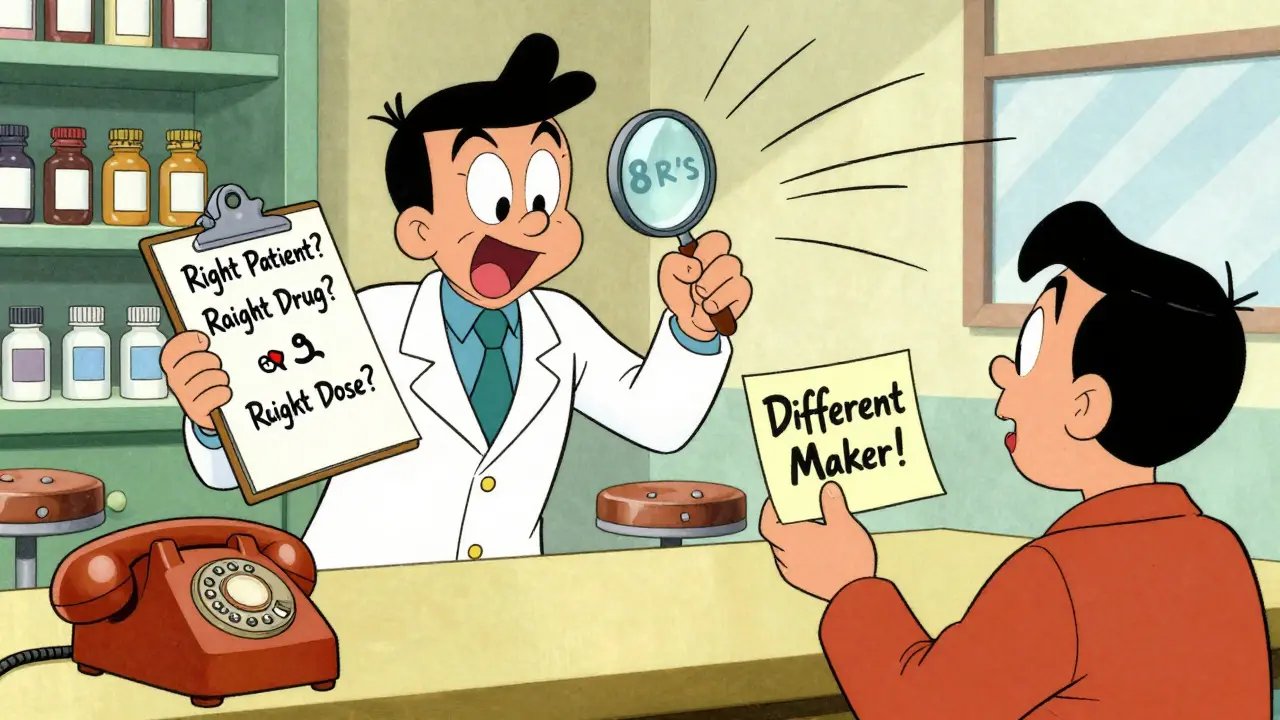
The Human Check: Counseling and the 8 R’s
The most powerful tool pharmacists have? Talking to patients.When a patient picks up a generic for the first time, a simple 3- to 5-minute conversation can catch 12-15% of errors. That’s not small. That’s life-changing.
Ask: “Have you taken this before?” “Do you notice any changes in how it looks or feels?” “Did your doctor tell you why you’re switching?”
Pharmacists also use the “8 R’s” to double-check every prescription:
- Right patient
- Right drug
- Right dose
- Right time
- Right route
- Right documentation
- Right reason
- Right response
Training staff on these steps takes 8-12 hours. It’s not flashy. But it works. One pharmacy that implemented the 8 R’s saw a 30% drop in dispensing errors in six months.
What Pharmacists Can Do Today
You don’t need a $75,000 software upgrade to reduce errors. Here’s what actually helps right now:- Update your drug references. 42% of pharmacists use outdated databases. Use Drug Facts and Comparisons or Epocrates. Update them yearly - it costs less than $300.
- Track manufacturer changes. When a generic switches makers, note it in the patient’s file. Even a sticky note on the bottle helps.
- Ask patients about changes. If they say, “This pill looks different,” don’t brush it off. Ask if they’ve had side effects before. That’s your safety net.
- Use color-coded labels. Mark new generics with a yellow sticker. Warn patients: “This is a different brand of the same medicine.”
- Join your pharmacy’s error reporting system. Only 28% of community pharmacies track errors. If yours doesn’t, start one. You’ll learn faster.
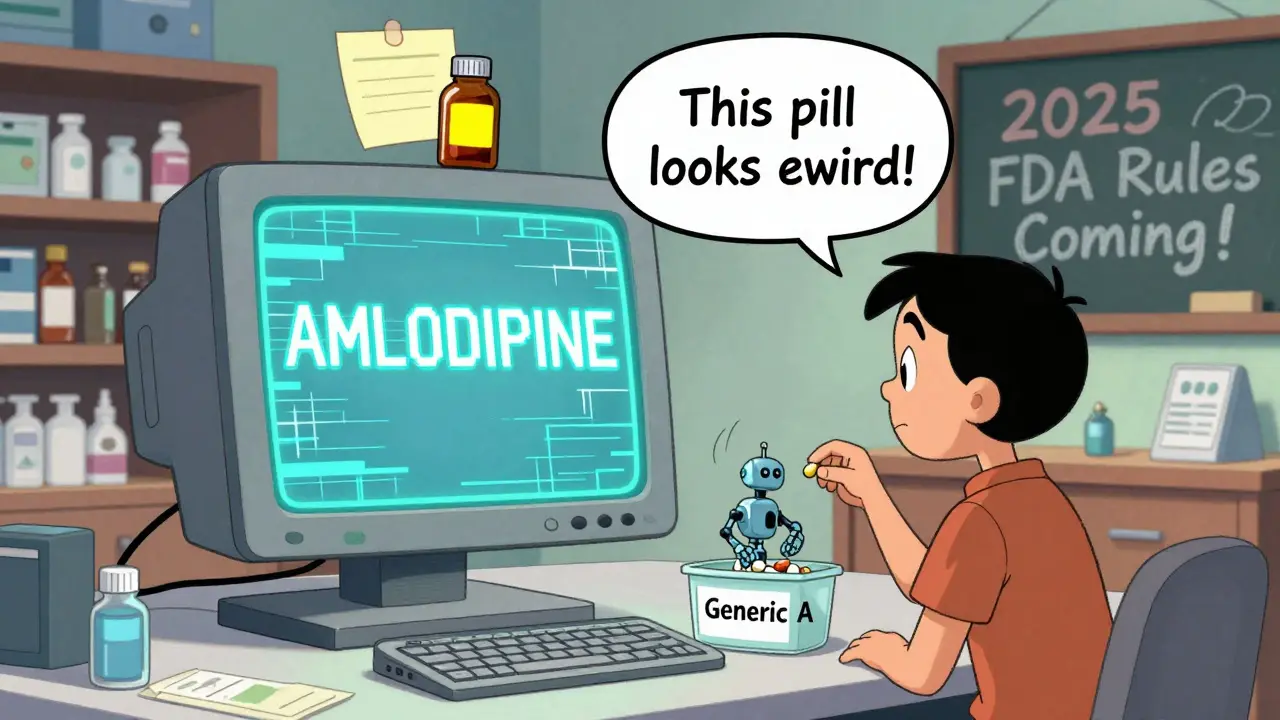
What’s Changing in 2025
The FDA and WHO are pushing for change. In 2022, the FDA updated its rules for generic labeling to require clearer manufacturer info. In 2023, the WHO recommended standardized naming to reduce look-alike errors. And the Leapfrog Group now requires hospitals to track generic substitutions across care settings.On the horizon: AI tools that predict which patients might react poorly to a specific generic based on their genetics. Pilot programs show these can reduce errors by 22% beyond current systems. But they’re still years away from mainstream use.
For now, the best defense is simple: knowledge, communication, and a little extra time.
What Patients Should Know
Patients don’t need to understand bioequivalence ranges or inactive ingredients. But they should know this:- Generics are safe and effective - when they’re the right one.
- If your pill looks different, it’s not necessarily a problem - but it’s worth asking about.
- Don’t assume the pharmacist knows what you were on before. Tell them.
- If you feel worse after a switch, say something. It’s not “in your head.”
Many patients stop taking their meds because they think the new version doesn’t work. It’s not always true. But it’s not always false, either. That’s why communication matters.
The Bottom Line
Generic drugs save billions. They make medicine accessible. But they also add complexity. The same system that lowers costs can also increase risk - if we’re not careful.Preventing errors isn’t about buying the latest software. It’s about asking questions. Double-checking labels. Listening to patients. Tracking changes. And never assuming that because two pills have the same name, they’re the same in every way.
Every pharmacist has the power to stop a mistake before it happens. It doesn’t take a miracle. Just attention.
Are generic medications less safe than brand-name drugs?
No, generic medications are not less safe. The FDA requires them to have the same active ingredient, strength, dosage form, and route of administration as the brand-name drug. They must also be bioequivalent - meaning they work the same way in the body. But differences in inactive ingredients or manufacturer variations can sometimes cause patient concerns or rare reactions. That’s why tracking which version a patient is on matters.
Why do generic pills look different each time I refill?
Generic drugs can be made by multiple manufacturers, and each one uses different colors, shapes, and markings for their pills. The FDA doesn’t require generics to match the brand-name appearance. So if your prescription switches from one generic maker to another, your pill might look completely different - even though it’s the same medicine. Always ask your pharmacist if you’re unsure.
Can generic substitution cause side effects?
Yes, in rare cases. While the active ingredient is identical, the inactive ingredients - like dyes, fillers, or preservatives - can vary between manufacturers. Some patients are sensitive to these and may experience rashes, stomach upset, or other reactions. If you notice new side effects after switching to a different generic version, report it to your pharmacist. They can switch you back or choose a different manufacturer’s version.
What’s the best way to prevent generic dispensing errors?
The most effective method is a combination of technology and human verification. Use updated drug databases, enable electronic alerts for look-alike drugs, and always perform the 8 R’s of medication safety. But don’t skip the final step: talking to the patient. Counseling at first fill catches up to 15% of errors. Never assume the patient knows what changed.
Do electronic health records help prevent generic errors?
They can - but only if they’re updated. Many systems don’t track which manufacturer’s generic a patient received last. They just list the drug name. Without that detail, alerts for substitutions or allergies won’t work properly. Pharmacies need to manually note manufacturer changes in patient files if their system doesn’t support it. Don’t rely on tech alone.
How often do pharmacy errors happen with generics?
While exact numbers for generics alone aren’t tracked, overall dispensing errors occur at a rate of 1.4 per 10,000 prescriptions. Since generics make up 90% of prescriptions, they’re involved in the vast majority of these errors. Prescription corrections - which include errors caught before reaching the patient - happen at 23.1 per 10,000 prescriptions. Many of these are due to dosage, strength, or form issues linked to generic variations.
What should I do if I think I got the wrong generic drug?
Don’t take it. Call your pharmacist immediately. Bring the bottle with you if you can. Ask: “Is this the same medication I was on before?” “Which manufacturer made this?” “Was there a change in strength or form?” Pharmacists are trained to verify these things. It’s better to be safe than sorry - even if you think you’re overreacting.
 Weekend Weight Gain: How to Stop Calorie Creep and Prevent Regain
 Celiac Disease in Children: Growth, Testing, and Diet Adherence
 Australia's Generic Market: PBS Overview and Impact
 How to Manage Medication Refills During Extended Travel
 Opioids and MAOIs: Why This Combination is Dangerous and How to Avoid It
Anna Weitz
December 27, 2025 AT 09:10Generics are just corporate laziness dressed up as savings
They make the same damn drug but change the color so you feel like you're getting a new experience
Meanwhile people are getting sick because their body remembers the old pill and the new one feels wrong
It's not placebo it's physiology
And nobody cares until it's their kid on the wrong dose
John Barron
December 27, 2025 AT 23:36While the article presents a compelling case regarding generic medication errors, it is imperative to acknowledge the systemic underpinnings of pharmaceutical commodification in the United States. The FDA’s bioequivalence standards, though ostensibly rigorous, fail to account for inter-individual pharmacokinetic variance, particularly in elderly and polypharmacy populations. Furthermore, the absence of mandatory manufacturer tracking in EHRs constitutes a critical lapse in pharmacovigilance infrastructure. One must also consider the economic disincentives for pharmacies to invest in personnel training when reimbursement models remain volume-based rather than quality-based. The 8 R’s protocol, while commendable, remains a Band-Aid on a hemorrhaging system. Structural reform-not merely procedural tweaks-is required to mitigate this public health crisis.
Liz MENDOZA
December 28, 2025 AT 05:46I’ve worked in community pharmacy for 12 years and this hits so hard
One time a sweet elderly lady came in crying because her anxiety med went from white oval to blue round and she swore it ‘didn’t work anymore’
We checked the script, it was the same generic-just a different maker
We sat with her for 10 minutes, explained it, gave her a yellow sticker, and asked her to call if she felt off
She came back two weeks later with a thank-you card
That’s the power of just listening
Technology doesn’t replace human care-it just makes it easier to skip it
Nicola George
December 29, 2025 AT 04:34Oh wow a 30% drop in errors from ‘8 R’s’? That’s wild
Meanwhile my pharmacy gets a new generic every Tuesday and the techs just shrug and say ‘it’s the same drug’
And the doctor’s office doesn’t even know which manufacturer we use
So yeah, let’s all just pray the patient doesn’t break out in hives or start hallucinating
Thanks for the checklist, I guess
Babe Addict
December 29, 2025 AT 16:04Y’all are overcomplicating this
It’s just bioequivalence 101
Generic = same active ingredient, same PK/PD profile
Any ‘reaction’ is either placebo or non-compliance
If your body ‘knows’ the old pill, you’re just emotionally attached to the shape
Also, 90% of prescriptions are generic because it works
Stop fearmongering with anecdotal rashes and call it what it is: anti-pharma hysteria
Satyakki Bhattacharjee
December 30, 2025 AT 23:21People are dying because we choose cheap over care
It’s not about science
It’s about greed
Big Pharma doesn’t care if you get sick
They just want you to keep buying pills
God will judge them
And we are all sinners for letting this happen
Kishor Raibole
December 31, 2025 AT 19:22It is with profound solemnity that I address the systemic erosion of pharmaceutical integrity in contemporary healthcare delivery. The commodification of medicinal agents, wherein aesthetic and inertial variability is permitted under the guise of fiscal prudence, constitutes a tacit violation of the Hippocratic Oath’s foundational tenet: primum non nocere. The proliferation of look-alike, sound-alike nomenclature, coupled with the absence of standardized manufacturer identification in electronic health records, represents not merely an operational deficiency, but a moral failure of regulatory oversight. One must question: if the FDA permits such variance, what other critical parameters are being sacrificed at the altar of market efficiency?
Olivia Goolsby
December 31, 2025 AT 23:34Okay but have you heard about the secret FDA loophole? They let generics use different dyes because ‘it’s cheaper’-but those dyes? They’re the same ones used in industrial paint and rat poison
And the manufacturers? They’re owned by the same companies that make the brand-name drugs
They just spin off a shell company so they can charge the same price but call it ‘generic’
And your EHR doesn’t track it because the software was built by a company that got a $20 million contract from Big Pharma
And the pharmacists? They’re overworked and underpaid so they just click ‘confirm’
And your doctor? They get kickbacks from the formulary
And the government? They’re too busy taking bribes to fix it
And you? You’re just another data point in a $400 billion scam
Don’t take your meds unless you know the exact batch number
And even then… you’re still being played