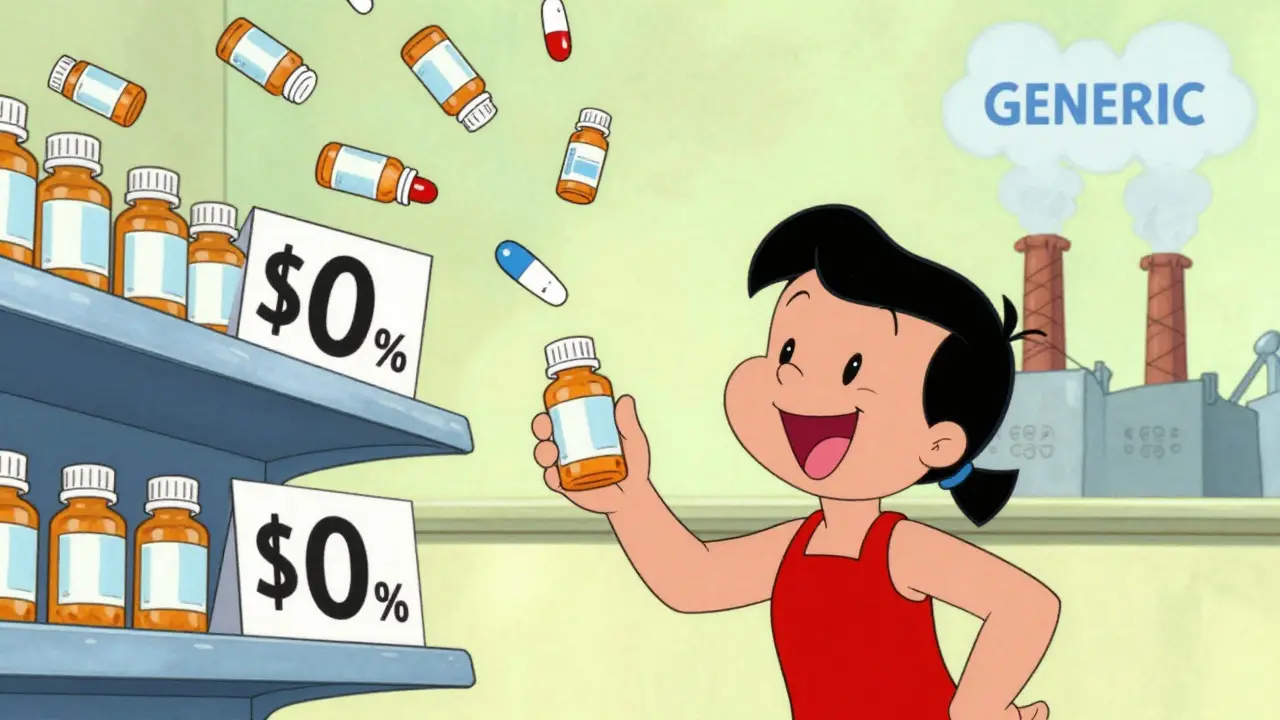
It’s a common myth that the U.S. pays the most for everything medical - especially drugs. But when it comes to generic drug prices, Americans actually pay less than people in most European countries. That’s right. While brand-name drugs in the U.S. cost nearly four times more than in Germany or France, the same generic pills - like lisinopril, metformin, or atorvastatin - often cost a fraction of what they do overseas. Why? It’s not luck. It’s structure.
How the U.S. Generic Market Works
In the U.S., 90% of all prescriptions filled are for generic drugs. That’s not because doctors prefer them - it’s because the system forces them into the market. Once a brand-name drug’s patent expires, dozens of manufacturers can start making the same pill. There’s no limit. No cap. No waiting list. Companies like Teva, Mylan, and Amneal jump in fast, flooding the market with identical products. Prices drop fast - sometimes below manufacturing cost. That’s why you can walk into Walmart or CVS and pay $4 for a 30-day supply of generic blood pressure medicine. In many cases, it’s even $0 with insurance. This isn’t accidental. It’s the result of a fragmented, competitive system. Pharmacy Benefit Managers (PBMs) negotiate rebates with manufacturers behind the scenes. They buy in bulk. They pressure pharmacies to favor the cheapest option. And because there are so many players, no single company can control the market. That’s the opposite of what happens in Europe.How Europe’s Generic Market Is Structured Differently
In most European countries, only about 41% of prescriptions are for unbranded generics. Why so low? Because the system doesn’t encourage it. Governments set prices through centralized negotiations. In Germany, France, and the UK, health agencies decide what a drug should cost - not the market. They look at what other countries pay. They ask if the drug is worth the price. They don’t care how much it cost to develop. This creates a quiet, slow-moving market. Generic manufacturers can’t just drop prices to win business. They’re stuck with government-set rates. If the price is too low, companies may stop making the drug - not because it’s unprofitable, but because the government won’t let them raise it. That’s why a month’s supply of generic lisinopril costs €15 in Germany but only $4 in the U.S. The European system protects profits - even for generics - and that keeps prices higher.Why the U.S. Pays More for Brand-Name Drugs
Here’s the twist: the U.S. pays way more for brand-name drugs. A single dose of Jardiance costs $204 in the U.S. but only $52 on average in other OECD countries. Stelara? $4,490 here, $2,822 abroad. Why? Because the U.S. doesn’t negotiate prices. Insurance companies, PBMs, and pharmacies all get rebates - but patients see the list price. Drugmakers know they can charge more here because there’s no single entity saying, “This is too high.” That’s why the U.S. spends $1,443 per person on drugs each year - nearly double what Germany or the UK spends. But here’s the real story: those high prices aren’t just about greed. They fund global drug innovation. About two-thirds of all new drug research is paid for by U.S. sales. When Europe pays $50 for a new cancer drug, the U.S. pays $500. That difference helps pay for the next breakthrough.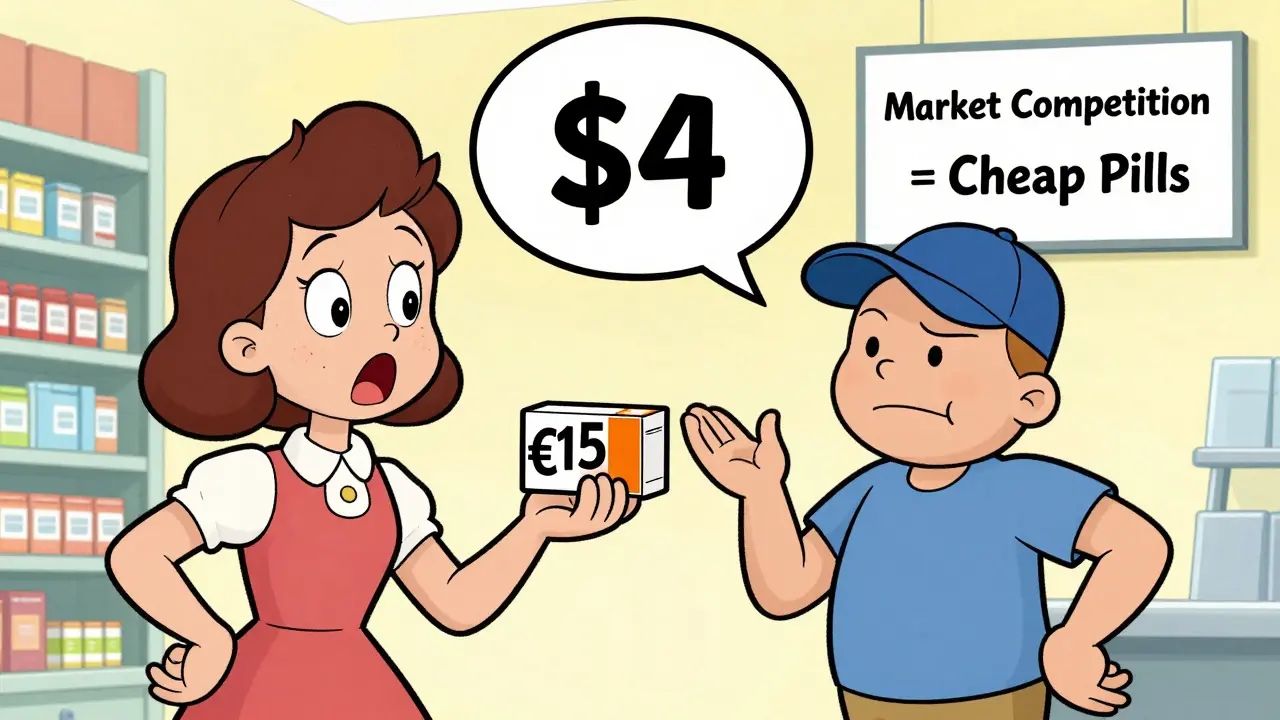
What Happens When Prices Go Too Low
There’s a dark side to the U.S. generic market. When prices drop too far, companies stop making the drug. If the profit margin is zero or negative, why bother? In recent years, shortages of essential generics - like antibiotics, heart meds, and thyroid pills - have spiked. One reason? Too many manufacturers left the market because they couldn’t make money. Then, one company got a monopoly. Prices jumped overnight. Dana Goldman, a health economist at USC, calls this the “race to the bottom.” It’s not a flaw in the system - it’s a feature. The system works when competition is fierce. But when competition disappears, the market breaks. That’s why some generics are now made in India or China, where labor and regulation costs are lower. The U.S. doesn’t produce most of its own generics anymore. It just buys them cheap.Patients Feel the Difference
Americans who travel to Europe often get shocked. One Reddit user wrote: “I paid €15 for generic lisinopril in Berlin. Back home, my copay is $4.” Meanwhile, Europeans visiting the U.S. are stunned by brand-name prices. A 2024 survey by the European Patients’ Forum found that 78% of respondents thought U.S. drug pricing was “unjustifiably high.” But here’s the catch: Americans don’t pay list prices. They pay after rebates. Europeans pay fixed co-pays - no matter if the drug is generic or brand-name. So while the sticker price looks better in the U.S., the real cost to the system is higher. In Europe, the government absorbs the cost. In the U.S., it’s split between insurers, PBMs, and taxpayers.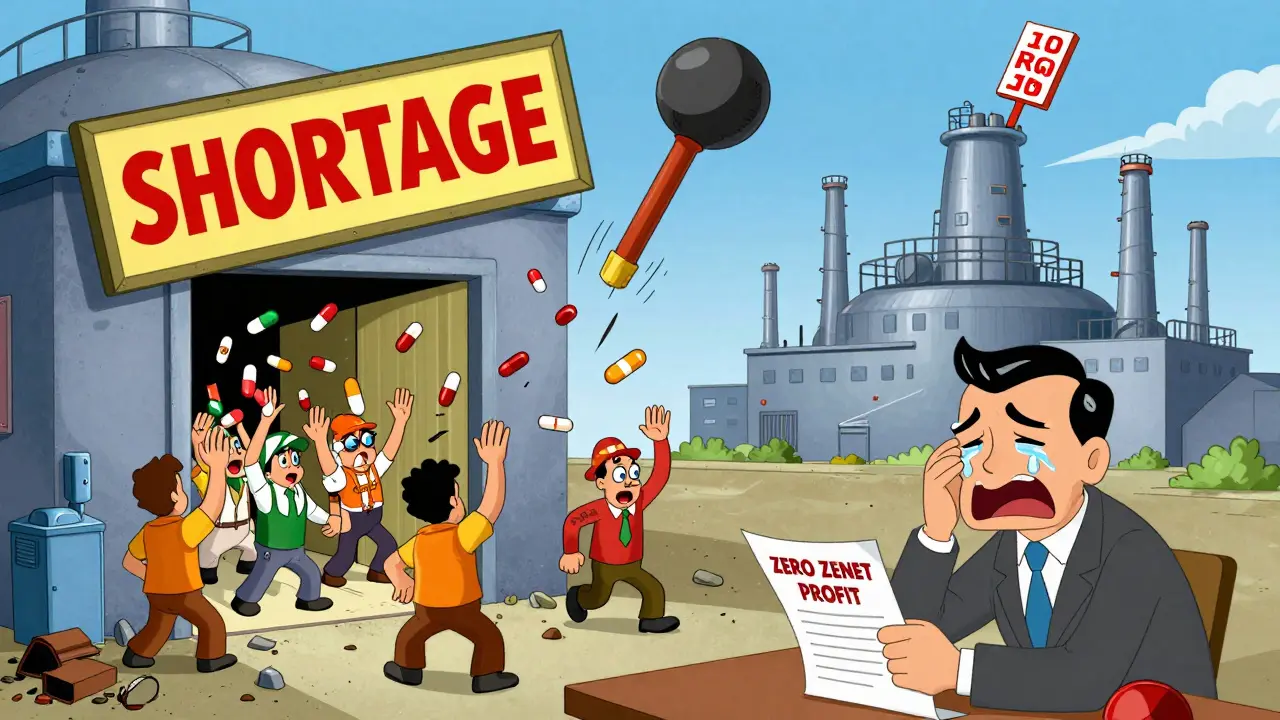
 Alcohol and Opioids: Understanding the Lethal Overdose Risk
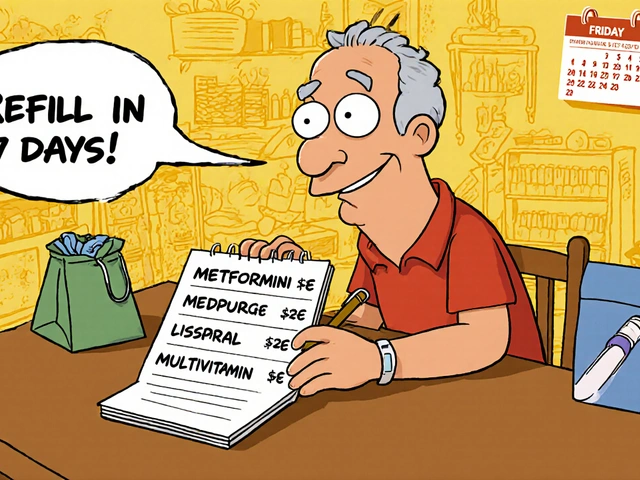 How to Set Up Medication Budgeting and Auto-Refill Alerts
 Where and How to Buy Calan Online Safely: Everything You Need to Know
 Exploring 7 Effective Alternatives to Atarax for Anxiety Relief and Allergy Management
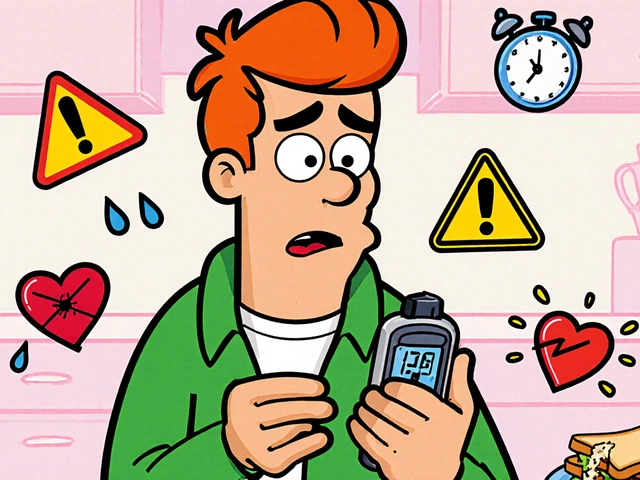 Insulin Therapy Side Effects: Managing Hypoglycemia and Weight Gain
Martin Viau
January 1, 2026 AT 04:34Let’s be real - the U.S. generic system is a fucking free-for-all. No price controls means manufacturers slash costs until they’re selling at a loss just to stay in the game. That’s not capitalism - it’s predatory discounting with a side of supply chain chaos. And don’t get me started on how 80% of these generics are made in India with regulatory oversight that’d make a FDA auditor cry. We’re not saving money - we’re outsourcing risk.
Meanwhile, Europe’s centralized pricing? It’s not broken - it’s just not designed to maximize shareholder returns. They care about sustainability, not stock tickers. Guess who’s paying for the innovation? Us. Always us.
And now Medicare’s negotiating? Good. But it’s too little, too late. We’ve been bleeding generic supply for a decade. When the last U.S. factory closes, who’s gonna fill the gap? China? Hope you like waiting six months for your blood pressure meds.
Robb Rice
January 2, 2026 AT 09:40Interesting analysis. I appreciate the breakdown of structural differences between the U.S. and European systems. The role of PBMs is often misunderstood - they’re not villains, they’re intermediaries operating under market pressure. The real issue is transparency. Patients don’t see the net price after rebates, and that’s a systemic flaw. Also, the point about innovation funding is critical - if the U.S. stops subsidizing R&D, global drug development slows. We’re not just consumers - we’re investors in medical progress.
Harriet Hollingsworth
January 2, 2026 AT 11:50Oh my god. So we’re supposed to be proud that we’re starving our own generic drug supply chain into oblivion just so Walmart can sell $4 pills? That’s not a win - that’s a crime. People are dying because the cheapest option is the only option, and when the cheapest disappears, the rest get gouged. And you call this ‘competition’? It’s a race to the bottom while families go bankrupt. This isn’t capitalism. It’s cruelty dressed up as efficiency.
Deepika D
January 3, 2026 AT 11:43Let me break this down for anyone who’s confused - the U.S. generic system works because it’s like a giant farmers market with 50 vendors selling the same tomatoes. One sells for $1, another for 75 cents, another gives them away for free to get customers in the door. That’s competition. But in Europe, it’s like one big grocery chain that says, ‘We’ll pay $2 for tomatoes, no matter what.’ So the farmers quit, and now you pay $2 for less fresh tomatoes.
The problem isn’t the system - it’s the lack of awareness. Most Americans don’t realize their $4 pill was made in a factory 8,000 miles away by workers earning $3/hour. And they don’t realize that the $200 cancer drug they’re paying for? That’s the same one Europe got for $50 - because the U.S. paid the R&D bill. We’re not just buying medicine - we’re funding the future. So yes, it’s messy. But it’s also the reason we have new treatments at all.
And yes, shortages happen. But that’s not because the system failed - it’s because we stopped investing in domestic manufacturing. Let’s fix that, not ban competition. Let’s build more factories. Let’s train more chemists. Let’s stop pretending the answer is to copy Europe. We can do better - and we have the tools to do it.
Bennett Ryynanen
January 3, 2026 AT 22:16Bro. You just paid $4 for lisinopril? That’s wild. I paid $18 last month. My PBM fucked me. This whole system is rigged. PBMs are middlemen who take a cut and then act surprised when prices go up. And don’t even get me started on how some of these generics are made in places where they don’t even test for heavy metals. I’d rather pay $20 for a pill I know is safe than $4 and risk my kidneys. We’re not saving money - we’re gambling with our health.
And yeah, Europe pays more - but they don’t have people skipping doses because they can’t afford the copay. We need to fix this. Not by copying them. By fixing our own damn system.
Chandreson Chandreas
January 4, 2026 AT 05:14It’s funny how we treat medicine like a commodity 🤔
The U.S. system is like a video game where you grind for the lowest price - but the game doesn’t tell you the NPCs are starving. Europe? They’re playing a different game - one where the goal isn’t to win the cheapest item, but to make sure everyone gets fed.
Neither is perfect. One leads to innovation with instability. The other leads to stability with stagnation.
Maybe the answer isn’t choosing sides - it’s building a third way. A system that values both access AND sustainability. 🌱💊
Just saying. We can do better than ‘$4 or bust’.
Darren Pearson
January 4, 2026 AT 07:06The structural analysis presented here is superficial at best. The implicit valorization of market competition as a panacea for pharmaceutical access reflects a fundamental misapprehension of the social contract underpinning healthcare. The U.S. model is not an example of efficiency - it is an exemplar of market failure disguised as consumer sovereignty. The fact that patients are shielded from list prices via rebates demonstrates not innovation, but obfuscation. Furthermore, the assertion that American consumers subsidize global innovation is a rhetorical device employed by pharmaceutical lobbyists to justify price gouging. The empirical evidence on R&D expenditure is not as monolithic as suggested. One must interrogate the allocation of capital: how much is spent on actual discovery versus marketing and shareholder returns? The answer, as multiple peer-reviewed studies indicate, leans heavily toward the latter.
Thus, the U.S. system is neither morally defensible nor economically sustainable. It is a rent-seeking architecture masquerading as a free market.
Stewart Smith
January 4, 2026 AT 09:14So let me get this straight - we’re proud that our drug prices are so low that companies can’t make money, so they stop making the drugs, so then the one company left charges $200 for a pill that used to be $4? Classic American innovation: break it, then charge double to fix it.
Meanwhile, Europe just says, ‘Hey, this is medicine, not a TikTok trend - let’s not let it disappear.’
And we wonder why people think we’re insane.
Retha Dungga
January 5, 2026 AT 20:36