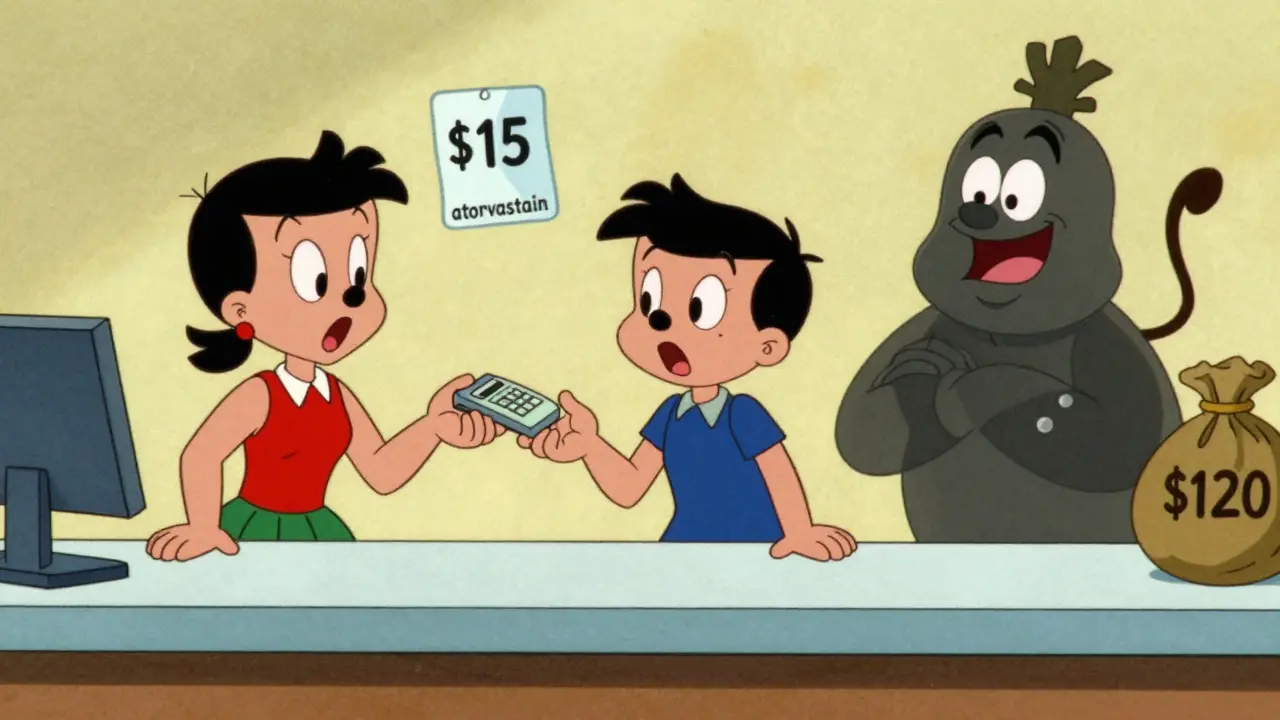
Have you ever filled a prescription for a generic drug and been shocked by the price-only to find out your friend in another state paid a third of what you did? It’s not a mistake. It’s not a glitch. It’s the reality of how generic drug pricing works in the U.S. The same pill, same manufacturer, same dosage-yet one state charges $12, another charges $80. Why? It’s not about the drug. It’s about the system.
It’s Not the Drug, It’s the Middlemen
Generic drugs are supposed to be cheap. After all, they’re copies of brand-name medicines with no R&D costs. Yet in 2025, Americans still pay more for generics than people in nearly every other developed country. The reason? It’s not the drugmakers. It’s the middlemen: pharmacy benefit managers, or PBMs. PBMs act as intermediaries between insurers, pharmacies, and drug manufacturers. They negotiate discounts, set reimbursement rates, and decide which drugs get covered. But here’s the catch: their contracts are secret. They don’t tell pharmacies what they paid for a drug. They don’t tell patients what the real cost is. And they don’t tell states how they’re setting prices. In some states, PBMs use a pricing formula that lets them pocket the difference between what they pay the pharmacy and what they charge the patient. That’s called spread pricing. In others, states have banned it. In California, transparency laws force PBMs to disclose their pricing. In Texas, they don’t. That’s why two people with the same insurance plan can pay wildly different amounts for the same generic atorvastatin-one pays $15, the other pays $120.State Laws Are the Wild West
The U.S. has no national rulebook for generic drug pricing. That means each state writes its own rules. And they’re all different. Vermont led the way in 2016 by requiring drugmakers to report price hikes. California followed with laws forcing PBMs to reveal their pricing models. Maryland tried to cap prices on certain generics-but a federal court struck it down in 2018, saying states can’t regulate interstate commerce. That ruling sent a chill through other states. Now, instead of directly controlling prices, most states focus on transparency. That’s why you see big differences. In states with strong transparency laws, patients pay 8-12% less on average for generics. In states with weak or no laws, prices stay high because there’s no pressure to change. Nevada passed a law targeting diabetes drug prices, but the lawsuit behind it was dropped. Why? Because manufacturers and PBMs threatened to sue under federal trade secrets law. The system is rigged to protect secrecy.Medicaid and Reimbursement Formulas
Medicaid, which covers low-income patients, pays pharmacies based on a benchmark called the National Average Drug Acquisition Cost (NADAC). But not all states use NADAC the same way. Some update it monthly. Others use a three-month average. Some add a fixed dispensing fee. Others don’t. That means a pharmacy in Florida might get reimbursed $2.50 for a 30-day supply of metformin, while one in New York gets $4.75. The pharmacy has to cover its rent, staff, and utilities. If the reimbursement is too low, they might charge patients more to make up the difference. Or they might just stop stocking the drug. And here’s the kicker: Medicaid reimbursement rates don’t always reflect what private insurers pay. So a patient on Medicare Advantage might pay $10 for the same drug that a Medicaid patient pays $15 for. It’s a mess.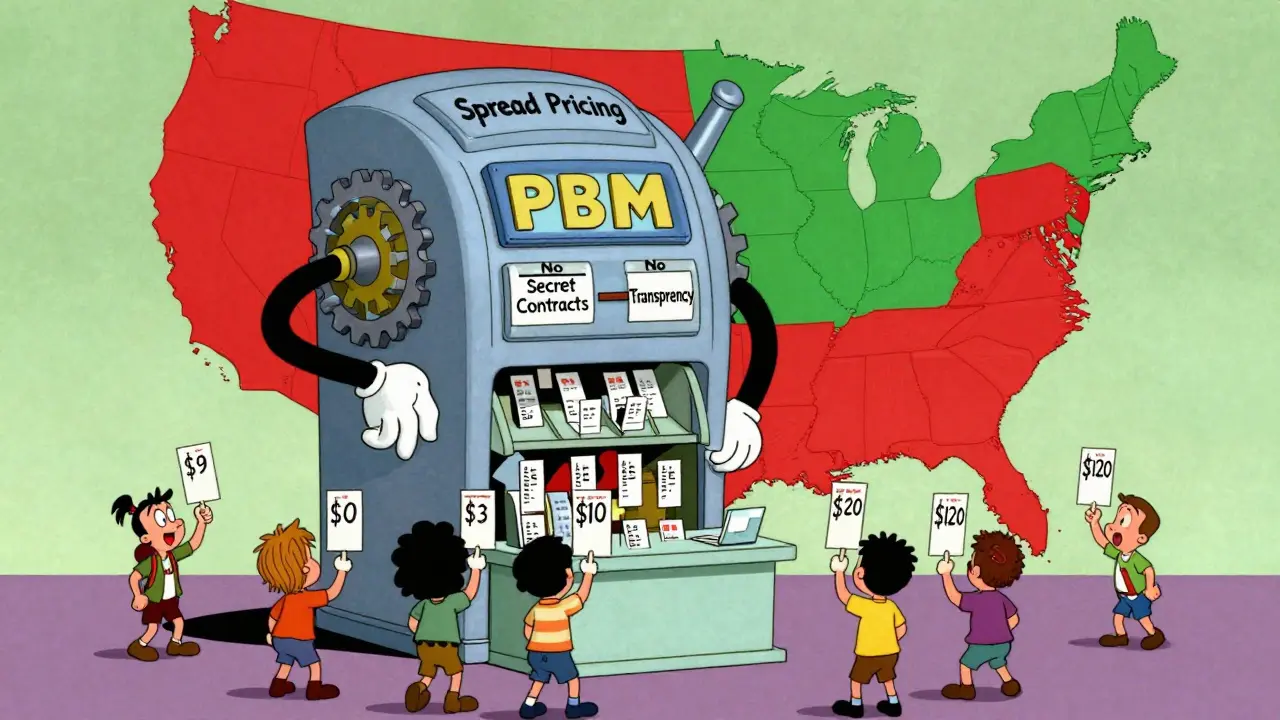
Competition (or Lack of It)
In cities with dozens of pharmacies, prices are lower. In rural towns with one pharmacy? Prices jump. Why? Because that pharmacy has no competition. It’s a monopoly. GoodRx data from 2022 showed price differences of up to 300% between neighboring counties in states like Arizona and Georgia. One pharmacy in a small town in rural Georgia charged $78 for a 90-day supply of lisinopril. Just 30 miles away, in a bigger town, the same drug cost $18. The only difference? Population density and pharmacy competition. Big pharmacy chains like CVS and Walgreens often have better deals with PBMs because they buy in bulk. Independent pharmacies? They’re left with the scraps. And when they can’t afford to stock certain generics, patients pay more-or go without.Cash Beats Insurance-Sometimes
Here’s something most people don’t know: paying cash for generics is often cheaper than using insurance. Why? Because when you use insurance, your PBM sets the price. But when you pay cash, you’re buying directly from the pharmacy at their wholesale cost. Services like GoodRx, Blink Health, and Mark Cuban’s Cost Plus Drug Company show you what pharmacies actually pay. In 2023, 4% of all U.S. prescriptions were paid in cash. Ninety-seven percent of those were for generics. A patient in Ohio paid $42 for a 90-day supply of simvastatin through their insurance. On GoodRx, the same prescription cost $9. In Alabama, a patient paid $110 with insurance. Cash? $14. This isn’t a trick. It’s how the system works. Insurance companies and PBMs profit from the gap between what they charge you and what they pay the pharmacy. When you pay cash, you cut them out.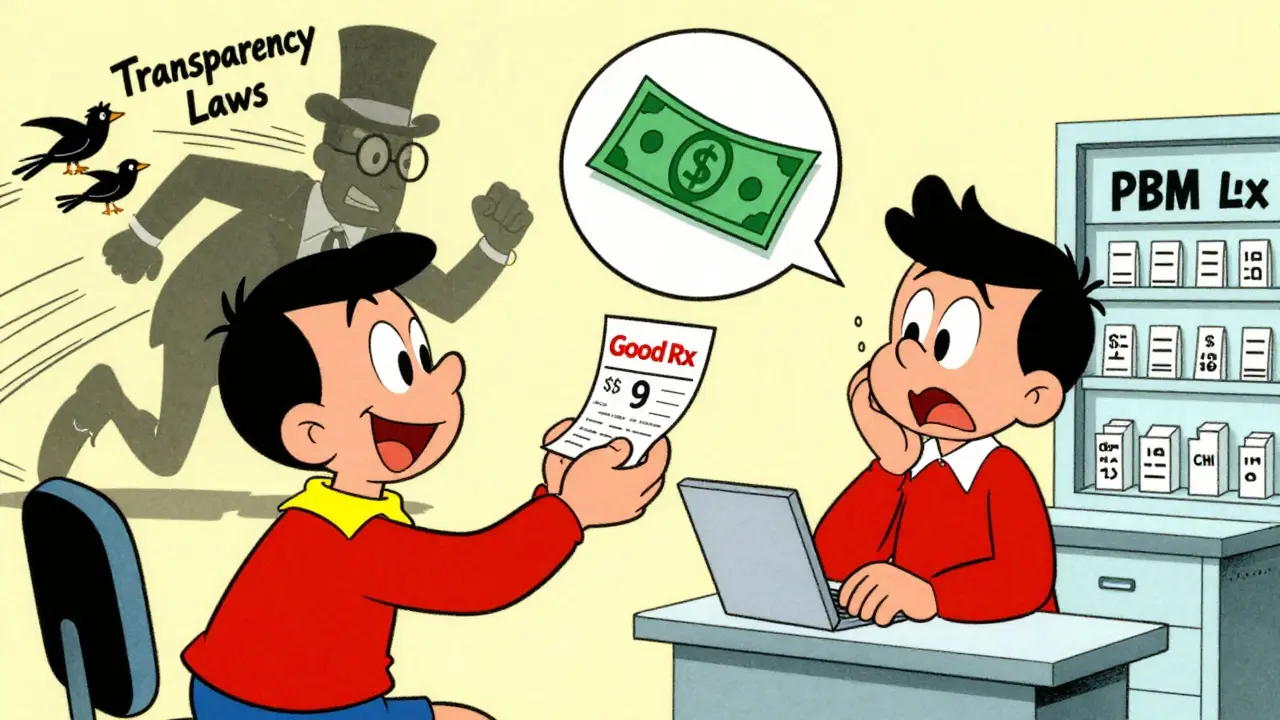
The Inflation Reduction Act Didn’t Fix This
The Inflation Reduction Act of 2022 got a lot of attention for capping insulin at $35 a month and setting a $2,000 annual out-of-pocket cap for Medicare Part D beneficiaries. But here’s the truth: those rules only apply to Medicare patients. That’s about 32% of U.S. drug spending. For the other 68%-people with private insurance, Medicaid, or no insurance-nothing changed. And even for Medicare patients, the savings vary by state. Why? Because the law doesn’t touch PBM pricing practices. It doesn’t force transparency. It doesn’t ban spread pricing. It doesn’t require PBMs to pass savings to patients. So while Medicare patients might save $18.5 billion by 2030, millions of others are still stuck with the same broken system.What You Can Do Right Now
You don’t have to accept whatever price you’re given. Here’s how to save money, no matter where you live:- Always check GoodRx or SingleCare before paying. Even if you have insurance, compare the cash price.
- Ask your pharmacist: “What’s your cash price?” Don’t assume insurance is cheaper.
- If you’re on Medicare, use the Medicare Plan Finder tool to compare drug costs across plans.
- In states with transparency laws (California, Colorado, Maine, Vermont, etc.), request a breakdown of your PBM’s pricing.
- Consider switching to a direct-purchase pharmacy like Cost Plus Drug Company if you take multiple generics.
Why This Won’t Get Better Soon
The drug pricing system isn’t broken because of bad actors. It’s broken because it was designed this way. PBMs, insurers, and pharmacy chains make billions from the gap between what drugs cost and what patients pay. They have lobbyists in every state capital. They fund studies that say “prices are fair.” They sue states that try to change the rules. The FDA approved over 800 generic drugs in 2017-the most ever. That should’ve driven prices down. But it didn’t. Why? Because the middlemen kept the savings. Until states force transparency, ban spread pricing, and stop letting PBMs operate in the dark, prices will keep varying wildly. And patients will keep overpaying-sometimes by hundreds of dollars-for pills that cost pennies to make.It’s not about where you live. It’s about who controls the system. And right now, that’s not you.
Why is my generic drug so much more expensive in my state than in others?
Generic drug prices vary by state because of differences in state laws, how pharmacy benefit managers (PBMs) set prices, Medicaid reimbursement rates, and local pharmacy competition. States with transparency laws (like California) tend to have lower prices because they force PBMs to disclose their pricing. In states without those rules, PBMs can charge more and keep the difference as profit. Your pharmacy’s location, not your prescription, determines your price.
Should I use my insurance or pay cash for generics?
Always compare both. Many times, paying cash through services like GoodRx or Cost Plus Drug Company is cheaper than using insurance-especially for generics. That’s because insurance often uses secret PBM pricing that inflates your cost. Cash prices reflect what the pharmacy actually paid for the drug, not what the PBM says you owe.
Do state laws really make a difference in generic drug prices?
Yes. A 2022 USC Schaeffer Center study found patients in states with strong transparency laws paid 8-12% less for generics than those in states with weak or no laws. California, Vermont, and Maine have laws requiring PBMs to report pricing, which reduces hidden markups. States without those laws see higher prices because there’s no accountability.
Why don’t drug manufacturers lower prices if generics are so cheap to make?
Manufacturers of generic drugs often sell to wholesalers or PBMs at very low prices-sometimes just pennies per pill. The problem isn’t the manufacturer’s price. It’s what happens after: PBMs, insurers, and pharmacies add markups, spread pricing, and hidden fees. The savings from low manufacturing costs never reach the patient.
Can I get cheaper generics if I live in a rural area?
It’s harder. Rural areas often have fewer pharmacies, which means less competition and higher prices. Your best bet is to use mail-order pharmacies or services like GoodRx to find the lowest cash price nearby. Some online pharmacies ship nationwide at fixed low prices, which can be cheaper than driving to a single local pharmacy that has no competition.
Is the Inflation Reduction Act helping with generic drug prices?
Only for Medicare beneficiaries. The Act caps insulin at $35 and sets a $2,000 annual out-of-pocket limit for Medicare Part D users. But it doesn’t touch PBM pricing, spread pricing, or state-level rules. For the 68% of Americans who aren’t on Medicare, generic drug prices remain unchanged and just as unpredictable.
 How to Manage Medication Storage in Shared Living Spaces: A Safety Guide
 Bean Pod Supplements: Science-Backed Benefits for Better Health and Wellness (2025 Guide)
 Combimist L Inhaler vs Alternatives: Detailed Comparison Guide
 Levonorgestrel Explained: Complete Guide to Uses, Safety, and How It Works
 Levofloxacin for Anthrax: What You Need to Know
Christopher King
December 26, 2025 AT 07:45They don’t want you to know this, but PBMs are basically digital loan sharks with PhDs in exploitation. They don’t just mark up prices-they engineer scarcity, manipulate data, and bury the truth in legalese so deep even lawyers get lost. The FDA approves generics, sure, but who controls the distribution? Who owns the algorithms that decide what you pay? It’s not corporations. It’s not even the government. It’s a shadow network of private equity firms, hedge funds, and former lobbyists who turned healthcare into a casino. And you? You’re the sucker holding the losing ticket. They’ve been doing this since the 90s. No one’s stopping them. Because if they did, the whole house of cards collapses-and who’s gonna pay for their yachts then?
Bailey Adkison
December 27, 2025 AT 08:20Stop blaming PBMs. The real issue is state interference in interstate commerce. Federal law preempts state price controls. Maryland tried to cap prices. Got sued. Lost. That’s not corruption-that’s constitutional law. If you want lower prices, stop demanding state-level fixes and push for national deregulation of pharmacy benefit management. Let the market work. Competition isn’t broken-it’s being strangled by bureaucracy.
Michael Dillon
December 28, 2025 AT 21:07Look I get the outrage but here’s the thing nobody talks about-most people don’t even know what their insurance actually covers. I used to pay $80 for metformin until I found out my local CVS had a $12 cash price. Just asked. No app. No code. Just walked up and said ‘what’s this cost if I don’t use insurance?’ They gave me the number. I paid $12. That’s it. The system isn’t rigged-it’s just opaque. And if you’re not asking questions, you’re letting them win.
Katherine Blumhardt
December 30, 2025 AT 18:22OMG I JUST REALIZED I WAS OVERPAYING FOR MY BP MEDS FOR 3 YEARS 😭 I used goodrx last week and paid $5 instead of $47… my pharmacist looked at me like I was crazy but i was like ‘this is what you actually paid??’ like why are we even using insurance for generics?? its like paying for a $10 coffee with a credit card that charges you $40 bc of ‘processing fees’
sagar patel
December 31, 2025 AT 18:31In India generics cost less than a cup of tea. Here, a pill costs more than a meal. The system is designed to extract wealth from the sick. No other country does this. No other. The US has turned healthcare into a predatory industry. It is not capitalism. It is feudalism with a pharmacy counter.
Linda B.
January 1, 2026 AT 19:27Oh wow. So the solution is to pay cash? How revolutionary. Meanwhile, the people who can’t afford to pay $14 upfront for lisinopril-those are the ones getting crushed. The system doesn’t just favor the wealthy-it actively punishes the poor. And you’re telling me the answer is to shop around like it’s Black Friday? That’s not empowerment. That’s cruelty disguised as advice.
Terry Free
January 2, 2026 AT 20:37You’re all missing the structural flaw. PBMs aren’t the problem-they’re symptoms. The real issue is the lack of price transparency in the supply chain. Manufacturers sell to wholesalers, wholesalers sell to PBMs, PBMs negotiate with pharmacies, pharmacies bill insurers, insurers bill patients. No one knows the true cost at any point. The fix isn’t regulation. It’s mandatory, real-time, auditable price disclosure at every node. If every transaction was visible, the arbitrage would collapse. But that would require accountability. And accountability scares the people who profit from opacity.
Sophie Stallkind
January 3, 2026 AT 23:58Thank you for this meticulously researched piece. The disparity in Medicaid reimbursement methodologies across states is particularly concerning. The fact that a pharmacy in Florida receives $2.50 for metformin while one in New York receives $4.75-despite identical acquisition costs-creates a cascading effect on patient affordability. This is not merely a market inefficiency; it is a systemic failure of equitable care delivery. I urge policymakers to standardize NADAC benchmarks and eliminate discretionary dispensing fees that disproportionately burden low-income populations.