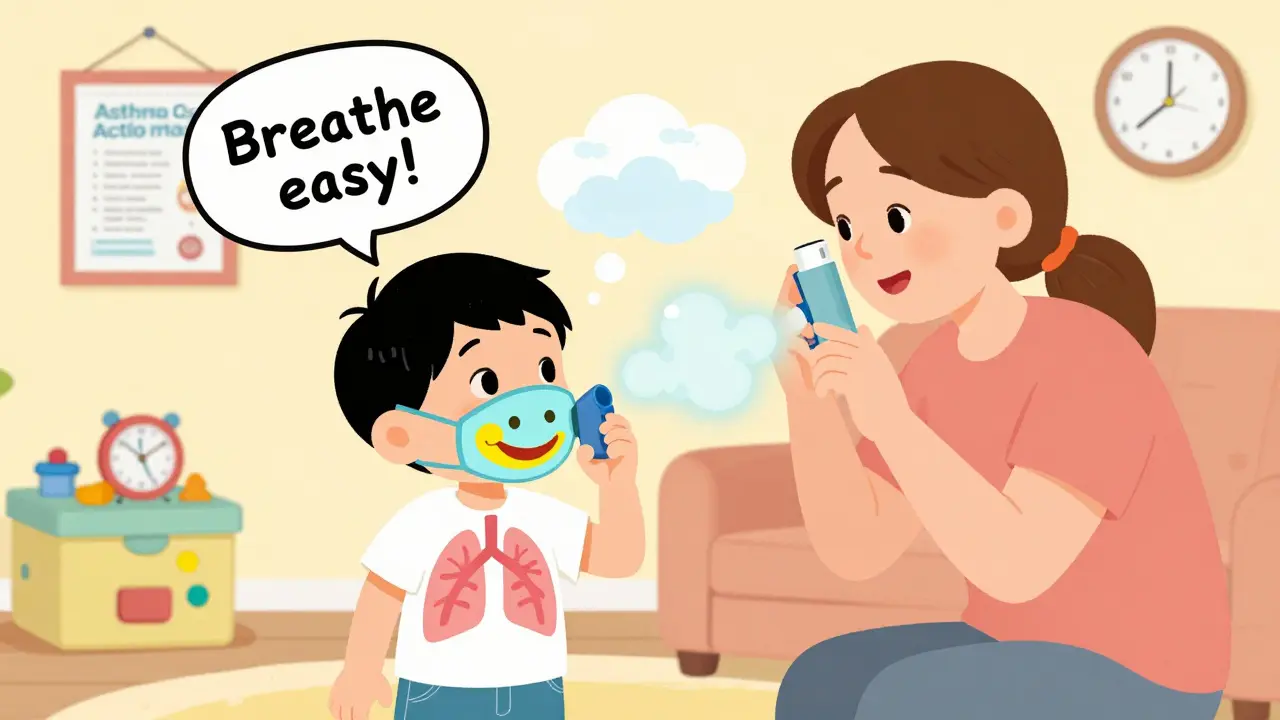
When a child has asthma, the difference between a normal day and a hospital visit often comes down to one small plastic tube-the spacer. It’s not flashy. It doesn’t have buttons or screens. But for millions of kids, it’s the quiet hero that keeps them breathing easy at school, at home, and during play.
Why Spacers Are Non-Negotiable for Kids
Many parents think a standard inhaler is enough. It’s not. Without a spacer, up to 80% of the medicine from a metered-dose inhaler (MDI) ends up stuck in the mouth or throat, not the lungs where it’s needed. That means less relief, more side effects like hoarseness or thrush, and a higher chance of emergency visits.
Spacers solve this. They’re hollow tubes-usually 10 to 20 centimeters long-that attach to the inhaler. When you press the inhaler, the medicine floats inside the spacer. The child then breathes in slowly, naturally, over four to five breaths. No timing needed. No coordination. Just breathe.
Studies show kids using spacers get 73% more medicine into their lungs compared to using an inhaler alone. For children under five, this isn’t just helpful-it’s critical. The American Academy of Pediatrics and Global Initiative for Asthma (GINA) both say spacers should be used with every inhaler for every child, no exceptions. A 2019 JAMA Pediatrics study found hospital admissions dropped from 20% with nebulizers to just 5% with spacers. That’s a 75% reduction in serious flare-ups.
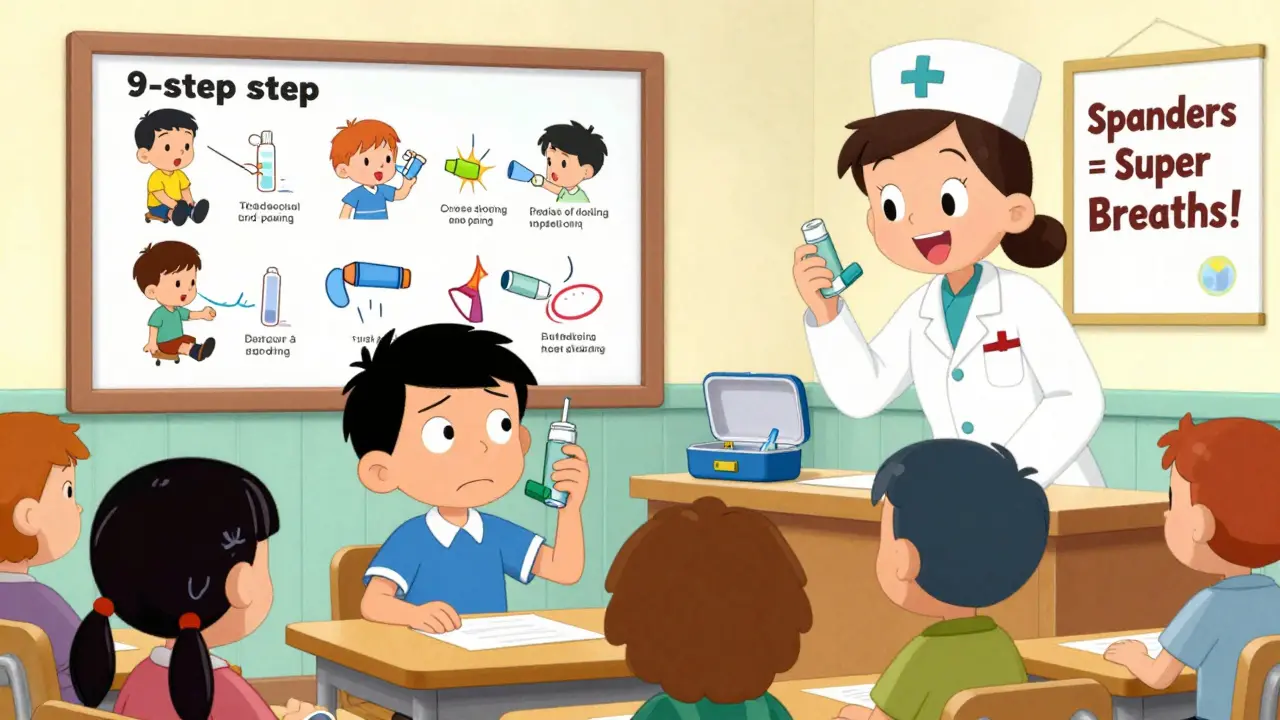
How to Use a Spacer Correctly (Step by Step)
It’s simple, but only if done right. Here’s the exact method trusted by hospitals:
- Have your child sit upright. Lying down or slouching makes it harder to breathe deeply.
- Attach the inhaler to the spacer. Make sure it’s snug.
- Hold the spacer and inhaler level. Tilting it lets medicine stick to the sides.
- Press the inhaler once-only once-to release the medicine into the spacer.
- Have your child breathe in and out slowly through the mouthpiece (or mask, if under 5) four times. Count to five with each breath.
- Wait 30 seconds before giving a second puff, if needed.
- Wash the spacer weekly with warm water and dish soap. Don’t rinse it. Just let it air-dry. Rinsing creates static that traps medicine.
- Never use a wet spacer. If it’s damp, use the inhaler alone until it’s dry.
- Keep it clean, dry, and always ready. A dusty or wet spacer doesn’t work.
For kids under five, use a mask. Older kids can use the mouthpiece. But if they’re breathing through their nose or the mask leaks, the medicine won’t reach the lungs. A 2022 study found 88.7% of kids under 8 used spacers correctly with a mask, but only 54.2% did so with just a mouthpiece. That gap shrinks as kids get older-but not always.
The School Problem: Why Kids Stop Using Spacers
Most kids do great at home. Then they hit school.
One parent on Asthma.com shared: “My 10-year-old refuses to carry his spacer to school. He says it makes him look weird.” That’s not unusual. Adolescents are especially sensitive to standing out. And many schools don’t make it easy.
Despite federal guidelines, only 42 states require schools to keep asthma meds on-site. Rural schools are 45% less likely to have spacers available than urban ones. Teachers aren’t trained. Nurses are stretched thin. And even when spacers are there, kids often forget to use them-or don’t know how.
Research shows teens (14-18) are 80% less likely to use inhalers correctly than younger kids. That’s not rebellion. It’s lack of support. A 2022 study in the Journal of School Nursing found schools with full asthma policies-including trained staff and spacer access-cut absenteeism by 37%. That’s 1 in 3 fewer missed school days.
What a Good Asthma Care Plan Looks Like
A care plan isn’t just a piece of paper. It’s a living document that tells teachers, nurses, and coaches what to do when symptoms start.
Every child with asthma should have an individualized Asthma Action Plan (AAP). It should include:
- Names and doses of all medications (including spacer type)
- When to use quick-relief vs. daily control meds
- Early warning signs (coughing, wheezing, tiredness during activity)
- When to call a parent or go to the ER
- Emergency contact numbers
- Permission for the child to carry their own inhaler and spacer (if allowed by state law)
Many schools now require this plan before the child can even start class. The National Asthma Education and Prevention Program (NAEPP) says it’s mandatory for students with asthma. But the plan only works if everyone knows it exists.
Parents should:
- Give a copy to the school nurse, homeroom teacher, and PE instructor
- Ask for a 15-minute training session for staff on spacer use
- Check in every 3-6 months to see if technique is still correct
- Make sure the child has a backup spacer at school
What’s New in 2026: Tech, Training, and Access
The good news? Things are improving.
In January 2024, the American Academy of Pediatrics updated its guidelines to push for mandatory spacer training for all school staff-not just nurses. The CDC’s 2023-2025 National Asthma Control Program is funding spacer distribution in underserved districts. More schools are now stocking spacers in health offices, gym lockers, and even classrooms.
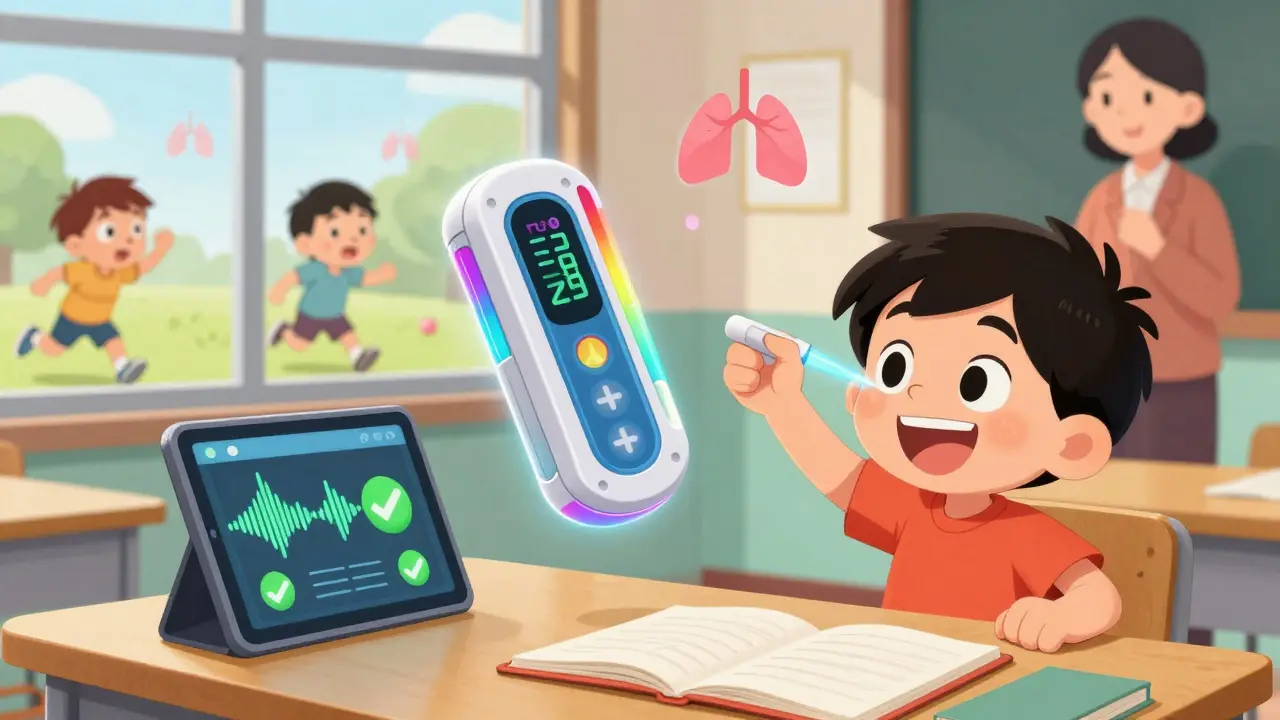
And innovation is coming. The NIH is funding a $2.5 million study to test smartphone apps that record and analyze a child’s inhaler technique. The app uses the phone’s microphone to listen to how the child breathes through the spacer and gives instant feedback. Early tests show it boosts correct use by 60% in just 4 weeks.
Spacers themselves are getting better, too. New models are lighter, foldable, and come in fun colors. Some even have built-in counters to track doses. No more guessing if the last puff was used.
What Parents Need to Do Right Now
You don’t need a medical degree to help your child manage asthma. You just need to act.
- Ask your pediatrician: “Is my child’s inhaler being used with a spacer?” If not, ask for one.
- Practice the 9-step technique with your child every day for a week. Make it a routine.
- Visit the school nurse and hand them a copy of the Asthma Action Plan.
- Ask: “Do you have spacers on hand? Are staff trained to use them?” If not, request training.
- Buy a second spacer for school. Keep it in a labeled case.
- Teach your child to say, “I need to use my inhaler and spacer,” without shame.
One mom in Ohio told us: “My 4-year-old went from two ER visits a month to zero after we started using the spacer properly. It wasn’t magic. It was just doing the right thing, every time.”
That’s the goal. Not perfection. Not fancy gear. Just consistency. A clean spacer. A calm child. And a school that knows what to do when things go wrong.
Frequently Asked Questions
Can my child use a spacer without a mask?
Yes, but only if they’re old enough to seal their lips tightly around the mouthpiece-usually around age 5 or older. For younger kids, a mask is required. Even then, the mask must fit snugly over the nose and mouth. If air leaks, the medicine escapes. Always check for gaps.
How often should I clean the spacer?
Wash it once a week with warm water and a drop of dish soap. Don’t rinse it after washing-just let it air-dry. Rinsing leaves behind water droplets that create static, which traps the medicine. A dry, unwashed spacer works best.
Can my child carry their own spacer to school?
It depends on your state’s laws and school policy. Most states allow children to carry their own asthma medication, including spacers, if they have a doctor’s note and parent consent. Check with your school nurse. Even if allowed, make sure your child knows how to use it correctly and isn’t embarrassed to do so.
What if the school doesn’t have a spacer?
You can provide one. Most schools are legally required to store asthma medication on-site, and spacers count. Give the school nurse a clean, labeled spacer and ask them to keep it in the health office. If they refuse, contact your local health department or the American Lung Association-they can help you advocate for compliance.
Are spacers covered by insurance?
Yes. Most insurance plans, including Medicaid and Medicare Advantage, cover spacers as durable medical equipment. You’ll usually need a prescription from your child’s doctor. Some manufacturers offer free or low-cost spacers through patient assistance programs-ask your pharmacist.
Can a spacer be used with any inhaler?
Most standard metered-dose inhalers (MDIs) work with any spacer. But check the instructions. Some newer inhalers, like dry powder inhalers (DPIs), don’t work with spacers at all. Always confirm with your doctor or pharmacist that your child’s inhaler is compatible with a spacer.
What should I do if my child’s spacer breaks?
Replace it immediately. A cracked or damaged spacer won’t hold medicine properly. Keep a spare at home and one at school. Most spacers last 6-12 months with regular use. If you notice cracks, discoloration, or a loose connection, get a new one. Don’t wait.
Next Steps for Parents and Schools
Start today. Don’t wait for an emergency.
For parents: Make sure your child’s spacer is clean, charged with medicine, and ready to go. Practice with them every morning. Talk to the school nurse. Ask if they’ve had asthma training this year.
For schools: Don’t assume someone else is handling it. Designate one staff member to manage asthma supplies. Keep a log of spacer usage. Offer a 15-minute refresher training every semester. It’s not extra work-it’s prevention.
Every child deserves to breathe without fear. Spacers make that possible. But only if they’re used-correctly, consistently, and without shame.
 Online Pharmacy roidsource.net Review: Safe Steroid Buying Guide
 How to Set Up Medication Budgeting and Auto-Refill Alerts
 Proven Strategies to Prevent Osteoporosis - A Complete Guide
 Lower GI Bleeding: Diverticula, Angiodysplasia, and How to Diagnose It
 Diabetes Medications Safety Guide: Insulin and Oral Agents Explained
Alexandra Enns
January 25, 2026 AT 20:05Okay but let’s be real - this whole spacer thing is just a Band-Aid for lazy parenting and underfunded schools. In Canada we’ve had this figured out since the 90s. Kids don’t need fancy apps or color-coded spacers. They need discipline. If your kid won’t use it at school, ground them. No more video games until they carry it like a responsible human. Stop coddling them. Asthma isn’t a personality trait.
Marie-Pier D.
January 26, 2026 AT 03:24My heart goes out to all the parents and teachers trying to do right by kids with asthma 💛 I’ve seen firsthand how a simple spacer can turn a scared child into a confident one. I always keep a spare in my bag - just in case. And yes, washing it without rinsing? Genius. I used to rinse mine and wonder why it never worked right 😅 Thank you for this clear, practical guide. Let’s make sure every school has one.
Josh McEvoy
January 26, 2026 AT 19:19Sawyer Vitela
January 28, 2026 AT 11:11Shanta Blank
January 30, 2026 AT 00:58Oh honey. We’re not talking about a plastic tube. We’re talking about a silent war against systemic neglect. Kids are getting wheezing punishments because their school doesn’t have a spacer stocked like it’s a box of crayons. And don’t even get me started on the teachers who say, 'Just tell me when you need it' like asthma is a RSVP. This isn’t healthcare - it’s a game of hot potato with a child’s lungs. And the worst part? The parents are tired. The nurses are crying. And the app that listens to their breath? That’s not tech. That’s survival.
Tiffany Wagner
January 30, 2026 AT 17:05Michael Camilleri
January 31, 2026 AT 05:44lorraine england
February 1, 2026 AT 23:54I love how you broke this down so clearly - thank you! I’m a school nurse and honestly? I cry every time a kid comes in gasping and we have to dig for a spacer. We’ve got one in the office, but only one. I’ve been asking for more since last fall. The district says 'budget constraints.' But they bought new smartboards. 🤷♀️ I’m handing out spacer care cards to every teacher next week. And yes - no rinsing! I learned that from a pharmacist who said, 'It’s like washing your glasses with soap and then wiping them with a wet towel.' 😅