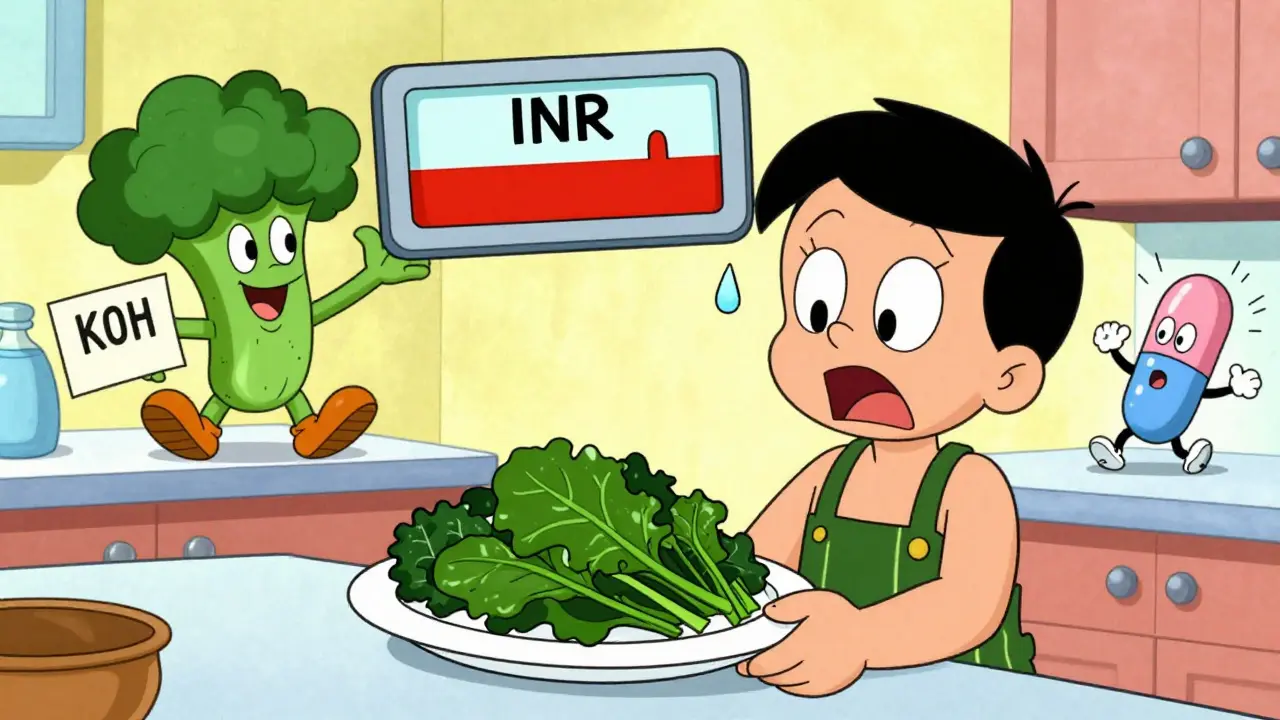
Managing your INR while on warfarin isn’t just about taking your pill on time. It’s about what’s on your plate. If your INR swings wildly - dropping too low or spiking too high - the culprit might not be your dosage. It could be your vitamin K intake.
Why Vitamin K Matters When You’re on Warfarin
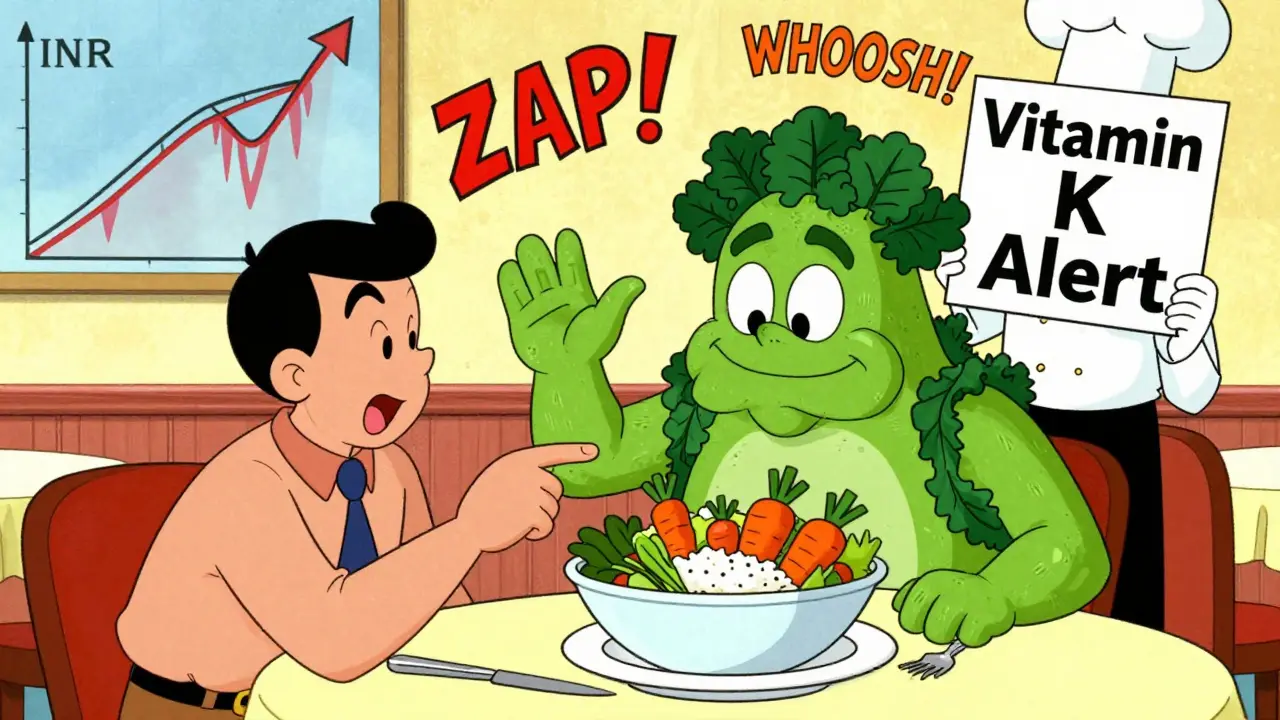
Warfarin works by blocking your body’s ability to recycle vitamin K. Without enough active vitamin K, your blood can’t form clots as quickly. That’s the whole point - to prevent dangerous clots. But here’s the catch: vitamin K from food fights back. Every time you eat a serving of spinach, kale, or broccoli, you’re giving your body the raw material to make clotting factors again. That can undo warfarin’s effect.If you suddenly eat more vitamin K than usual, your INR drops. Your blood clots faster. That raises your risk of stroke or pulmonary embolism. If you eat less - say, you skip your daily salad - your INR climbs. You bleed too easily. A nosebleed that won’t stop, or a bruise the size of a baseball, could be warning signs.
The goal isn’t to avoid vitamin K. It’s to keep it steady. The American College of Chest Physicians says you should aim for the same amount every day - within 10-15% variation. That’s it. No extreme low-vitamin K diet. No bingeing on greens one week and switching to iceberg lettuce the next.
Which Foods Are High in Vitamin K?
Not all veggies are created equal. Some pack a serious punch. Here’s what to watch for:- Kale: 547 mcg per cup, cooked
- Spinach: 889 mcg per cup, cooked
- Broccoli: 220 mcg per cup, cooked
- Brussels sprouts: 219 mcg per cup, cooked
- Green cabbage: 108 mcg per cup, chopped
- Collard greens: 772 mcg per cup, cooked
- Turnip greens: 529 mcg per cup, cooked
- Mustard greens: 419 mcg per cup, cooked
Even a single cup of cooked kale can drop your INR by 0.5-1.0 in just a few days. That’s enough to push you out of the therapeutic range - and into danger.
On the flip side, low-vitamin K foods are safe to eat without worry. Think:
- Iceberg lettuce (17 mcg per cup)
- Cucumbers (8 mcg per cup)
- Onions (4 mcg per cup)
- Carrots (13 mcg per cup)
- Apples, bananas, berries
- White rice, pasta, bread
- Chicken, beef, fish (unless it’s liver)
Don’t get fooled by the word “healthy.” Just because a food is good for you doesn’t mean it’s safe for your INR. Avocados? Great for heart health. 50 mcg per half - borderline high. Eat them daily? Fine. Eat two avocados one day and none the next? That’s a recipe for INR chaos.
How Much Vitamin K Should You Eat?
The average adult needs 90-120 mcg of vitamin K per day. But if you’re on warfarin, that number isn’t a target - it’s a baseline. You’re not trying to hit 90 mcg. You’re trying to hit the same number every single day.Most people on warfarin do well with 60-100 mcg daily. But the exact amount depends on your body, your dose, and your genetics. Some people need more. Some need less. The only way to know is to track your INR and your food.
Here’s a real example: One patient in Perth tracked his meals for six months. He ate exactly one cup of cooked broccoli every day (220 mcg). His INR stayed rock solid at 2.7. Then he switched to steamed kale (547 mcg) twice a week. His INR dropped to 1.8. He had to increase his warfarin dose by 25%. He went back to broccoli - INR returned to 2.7. No other changes. Just one food swap.
Consistency beats perfection. You don’t need to be a nutritionist. You just need to be predictable.
What About Cooking and Preparation?
How you cook your greens changes vitamin K content. Boiling spinach? You lose up to 50% of the vitamin K. Steaming? You keep most of it. Stir-frying? Minimal loss. That means if you used to eat boiled spinach and suddenly start eating it raw, you’re doubling your vitamin K intake without realizing it.Same with frozen vs. fresh. Frozen spinach is often blanched before freezing, which reduces vitamin K. Fresh spinach? Full strength. Don’t assume frozen is safer - check the label or use an app.
Portion size matters too. A handful of spinach in a smoothie? Maybe 20 mcg. A full cup cooked? 889 mcg. Use measuring cups. Don’t eyeball it. Your INR will thank you.
What About Supplements and Other Interactions?
Some people take vitamin K supplements - thinking it will help. But unless your doctor tells you to, don’t. A 2022 study in Blood Advances found that taking 150 mcg of vitamin K daily actually stabilized INR in people with erratic diets. But that’s medical advice, not a DIY fix. If you’re thinking about supplements, talk to your anticoagulation clinic first.Other supplements can interfere too:
- Green tea: Can raise INR. Avoid large amounts.
- Ginseng: May reduce warfarin’s effect.
- St. John’s Wort: Speeds up warfarin metabolism - dangerous.
- Garlic and ginger: Can increase bleeding risk, especially in high doses.
Even over-the-counter painkillers like ibuprofen or naproxen can increase bleeding risk when combined with warfarin. Stick to acetaminophen (paracetamol) if you need pain relief.
Real-Life Challenges: Eating Out, Travel, and Holidays
This is where most people stumble. You’re on vacation. You eat at a restaurant. The salad comes with kale and spinach. You don’t know how much vitamin K is in it. Your INR spikes or crashes. Emergency room visit. That’s not rare. In fact, 63% of warfarin users who’ve had an INR-related emergency say it happened while traveling or eating out.Here’s how to handle it:
- Ask for dressing on the side - oils and butters can be high in vitamin K.
- Choose grilled chicken or fish over liver or dark leafy greens.
- Stick to rice, mashed potatoes, or plain bread as sides.
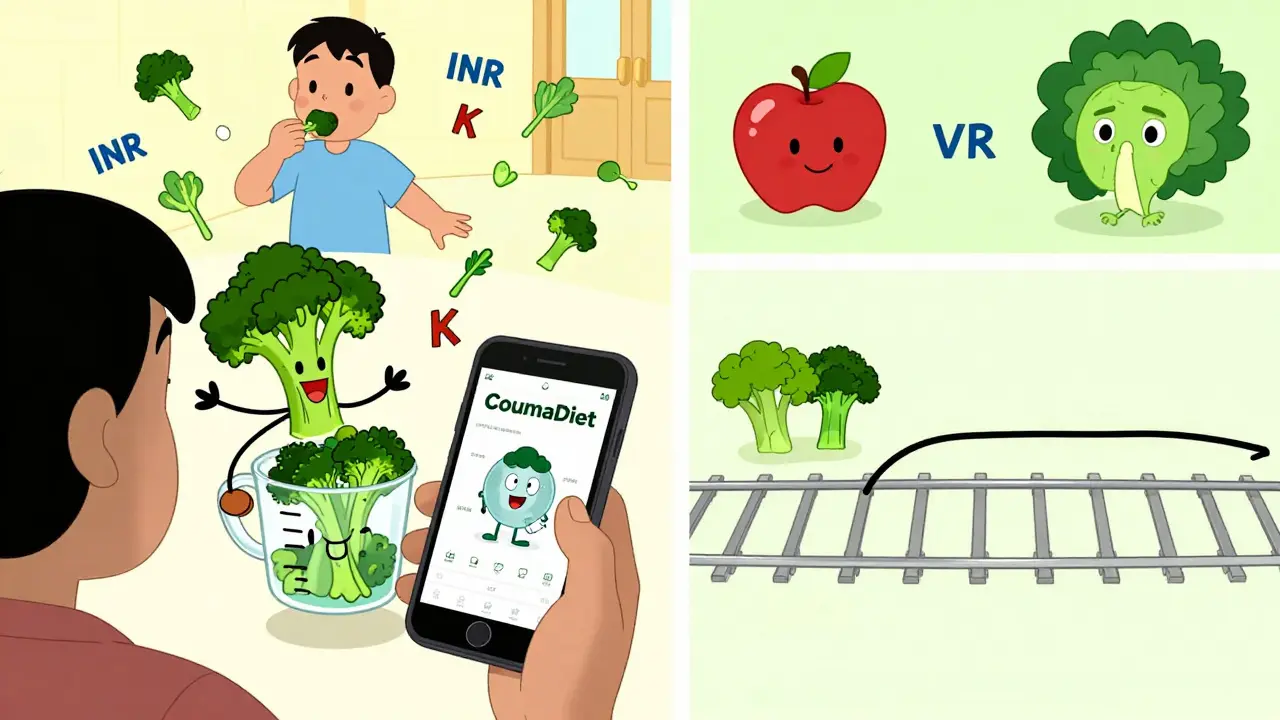
- Use the CoumaDiet app (rated 4.6/5 on Apple Store) to scan menu items.
- If you’re unsure, skip the greens. You can eat them again tomorrow - same amount.
One patient in Melbourne used to avoid restaurants entirely. Then she started using the app and asking simple questions: “What’s in the salad?” “Is it raw or cooked?” She now travels without fear. Her INR hasn’t been out of range in over a year.
Tools and Support
You don’t have to figure this out alone. Anticoagulation clinics offer free tools:- Food logs with vitamin K values
- Mobile apps like CoumaDiet or DoseMeRx
- Registered dietitians who specialize in warfarin
Studies show that patients who get structured dietary education reduce INR instability by 37%. That’s huge. If your clinic doesn’t offer this, ask for a referral. You deserve it.
Also, get your INR checked monthly - no exceptions. Even if you feel fine. INR changes without symptoms. That’s why it’s called the silent balance.
The Bottom Line
You don’t need to give up your favorite foods. You just need to keep them consistent. Eat your broccoli every day. Don’t swap it for kale unless you’re ready to adjust your dose. Use an app. Measure your portions. Ask questions when you eat out. Talk to your doctor if your INR moves more than 0.5 points.People who stick to a steady vitamin K intake spend more than 70% of their time in the therapeutic range. Those who don’t? Under 35%. That’s not a small difference. It’s the difference between living safely and ending up in the hospital.
Warfarin isn’t going away. It’s still the only option for mechanical heart valves and antiphospholipid syndrome. And for millions of people, vitamin K is the key to staying out of danger.
Keep it steady. Track it. Don’t guess.
Can I eat leafy greens if I’m on warfarin?
Yes - but only if you eat the same amount every day. A cup of cooked spinach or kale daily is fine. Swinging between 2 cups one day and none the next is dangerous. Consistency matters more than avoidance.
Does cooking reduce vitamin K in vegetables?
Yes, boiling can reduce vitamin K by 30-50%. Steaming or stir-frying preserves most of it. So if you switch from boiled spinach to raw spinach, you’re consuming far more vitamin K than you realize. Keep your cooking method consistent too.
What happens if I miss a dose of warfarin?
If you miss one dose, take it as soon as you remember - but only if it’s the same day. Never double up the next day. If you miss two or more doses, call your anticoagulation clinic. Your INR can rise quickly, especially if you’ve been eating high-vitamin K foods. Don’t wait for symptoms.
Are there foods that lower INR without vitamin K?
No food directly lowers INR unless it contains vitamin K. But some things can affect how warfarin works - like alcohol (heavy drinking raises INR), antibiotics (can raise or lower INR), and certain herbal supplements. Always check with your doctor before starting anything new.
Should I take a vitamin K supplement to stabilize my INR?
Only if your doctor recommends it. A 2022 study showed that 150 mcg of daily vitamin K stabilized INR in people with erratic diets. But this is not a DIY solution. Taking vitamin K without medical supervision can be dangerous. Always talk to your anticoagulation team first.
How often should I check my INR?
Monthly is standard for stable patients. If your INR has been swinging, you may need to check every 1-2 weeks until it stabilizes. Some clinics offer home testing devices. Ask if that’s an option for you. More frequent testing means fewer surprises.
Can I switch from warfarin to a DOAC to avoid vitamin K issues?
Maybe - but not always. DOACs like apixaban or rivaroxaban don’t interact with vitamin K. But they’re not safe for everyone. If you have a mechanical heart valve, antiphospholipid syndrome, or severe kidney disease, warfarin is still the only option. Talk to your cardiologist before switching.
Next Steps for Better INR Control
Start today. Pick one thing:- Download CoumaDiet or another vitamin K tracker app.
- Write down your daily vitamin K intake for one week.
- Ask your pharmacist or clinic for a printed food list.
- Plan your meals ahead - keep your greens consistent.
- Call your anticoagulation clinic and ask about dietary education.
Small changes. Big results. Your blood doesn’t care if you’re busy, tired, or stressed. It only cares if your vitamin K is steady. Make it simple. Make it routine. Your life depends on it.
 Pharmacy Errors with Generics: How to Prevent and Fix Common Mistakes
 Nephrotic Syndrome: Understanding Heavy Proteinuria, Swelling, and Real Treatment Options
 Tizanidine and Ciprofloxacin Interaction: Risks of Severe Hypotension and Sedation
 How to Bring a Caregiver or Advocate to Medication Appointments
Virginia Seitz
December 16, 2025 AT 11:12Just ate a kale smoothie and my INR dropped like a rock 😅 guess I’m not doing this right…
amanda s
December 17, 2025 AT 08:56Who the hell lets their blood clotting be controlled by a salad?? This is why America’s healthcare is broken. You’re not a vegetable calculator, you’re a person! 😤
Peter Ronai
December 18, 2025 AT 17:37Everyone’s missing the real issue here. Vitamin K isn’t the problem - it’s the pharmaceutical industry pushing warfarin because it’s profitable. DOACs are safer, cheaper, and don’t require you to become a nutritionist. But you won’t hear that from your clinic because they’re paid per INR test. Wake up.
Nishant Desae
December 19, 2025 AT 05:02Hey everyone, I’ve been on warfarin for 7 years now and I can tell you this - consistency is everything. I used to eat spinach every day, then one week I switched to kale because I thought it was "healthier" and my INR went from 2.4 to 1.6 in 3 days. Scary stuff. Now I eat exactly one cup of cooked spinach every morning, same time, same way. I don’t even think about it anymore. It’s just part of my routine. And yeah, I use the CoumaDiet app - it’s free and actually works. Also, if you’re from India, try mustard greens - they’re common here and I’ve found they’re easier to track than kale. Just keep it steady, you got this 💪
Jody Patrick
December 20, 2025 AT 07:34Don’t forget frozen spinach is lower in K than fresh. I boil mine to cut the K in half. Works for me.
Radhika M
December 20, 2025 AT 20:28Yes! This is so true. I’m a nurse in Delhi and I’ve seen patients panic over kale. But if they eat it every day? No problem. It’s the swings that kill. Keep it simple. Same food. Same amount. Same time. You don’t need to be perfect - just predictable.
Philippa Skiadopoulou
December 21, 2025 AT 21:12While the advice is sound, the emphasis on portion measurement is critical. A single cup of cooked spinach contains nearly 900 mcg - far exceeding daily needs. Consistency is paramount, yet many patients underestimate the variance between raw and cooked forms. Documentation of intake remains underutilized.
Pawan Chaudhary
December 22, 2025 AT 21:05Man, I used to stress out over this stuff till I started using the app and just picked one green and stuck with it. Now I eat my broccoli every night like clockwork. No more ER visits. Life’s better when you don’t overthink it 😊
Jonathan Morris
December 24, 2025 AT 16:04Let’s be real: the entire vitamin K narrative is a distraction. The real danger is unregulated food labeling. The USDA database is outdated. That "220 mcg per cup of broccoli"? It’s based on 1998 samples. Modern farming has altered nutrient profiles. No one’s validating these numbers. Your INR is being manipulated by flawed data. This isn’t nutrition - it’s guesswork dressed as science.
Linda Caldwell
December 25, 2025 AT 17:09Just started tracking my greens with the app and my INR hasn’t budged in 3 weeks. I used to eat salad every day but never measured. Now I know - it’s not about being healthy, it’s about being predictable. You can do this. One cup. Every day. No drama. 💪🥗
Anna Giakoumakatou
December 26, 2025 AT 02:27How quaint. You’ve turned your entire life into a spreadsheet to appease a 70-year-old anticoagulant. Meanwhile, people in Europe are on DOACs and enjoying avocado toast without fear. You’re not managing your health - you’re performing it for a system that profits from your anxiety. Bravo.