PPI-Antifungal Interaction Checker
Check Your Combination
Select both drugs to see interaction details
When you’re taking a proton pump inhibitor (PPI) for acid reflux and suddenly need an antifungal for a stubborn yeast infection, things get complicated-fast. These two types of drugs don’t just sit quietly in your body. They bump into each other in ways that can make one or both of them fail. And it’s not just a theoretical concern. Real people, in real hospitals, are getting sicker because of this interaction.
Why PPIs Mess with Antifungal Absorption
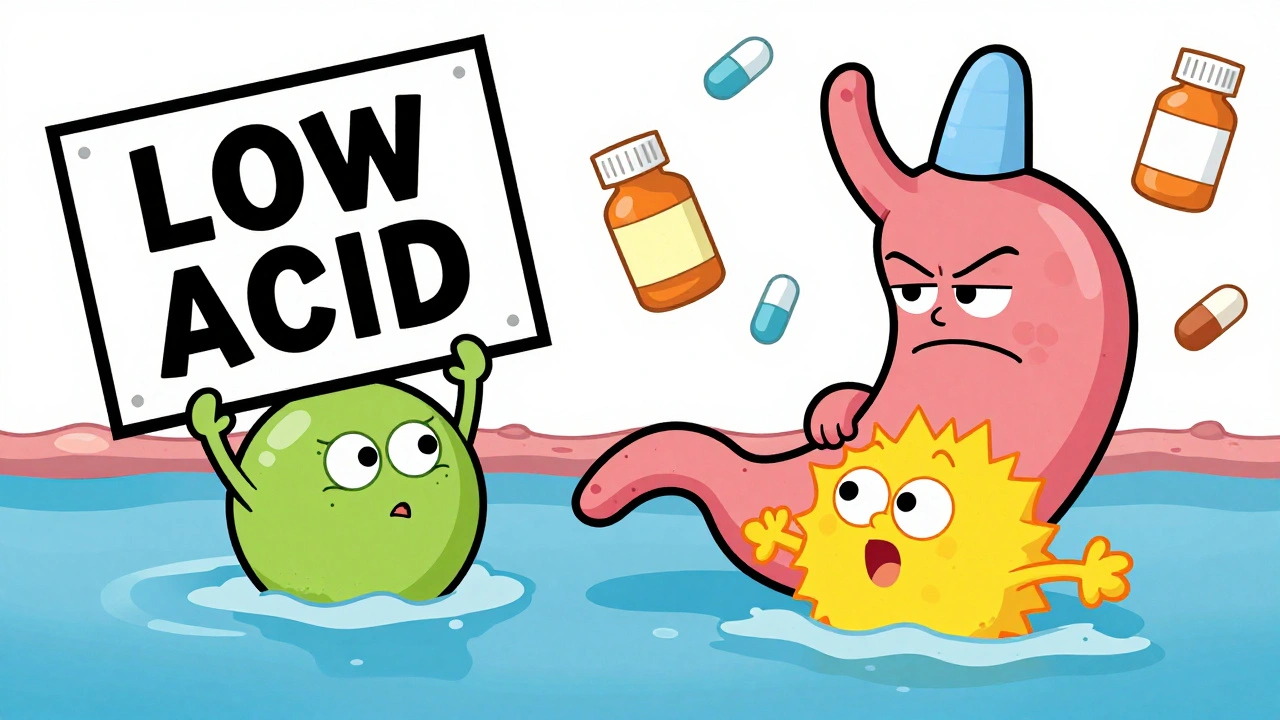
Proton pump inhibitors like omeprazole, pantoprazole, and esomeprazole work by shutting down stomach acid production. That’s great if you have heartburn. But for certain antifungals, low stomach acid is a disaster. Drugs like itraconazole and ketoconazole need that acidic environment to dissolve properly. Without it, they can’t get absorbed into your bloodstream. A 2023 study in JAMA Network Open tracked over 1,200 patients and found that when PPIs were taken with itraconazole, the amount of drug in the blood dropped by 60%. That’s not a small tweak-it’s enough to push levels below what’s needed to kill fungi. Ketoconazole isn’t much better. At a stomach pH of 6.8, its solubility crashes to just 0.02 mg/mL, compared to 22 mg/mL at pH 1.2. That’s a 1,100-fold drop.Fluconazole: The Exception That Proves the Rule
Not all antifungals are affected the same way. Fluconazole doesn’t care about stomach acid. It’s highly water-soluble, dissolves easily, and gets absorbed no matter how high your pH is. Its bioavailability stays steady at 90%±5%, even with PPIs in the system. That’s why doctors often switch patients from itraconazole to fluconazole when acid-reducing meds are needed. But here’s the catch: fluconazole isn’t harmless in this mix. It blocks a liver enzyme called CYP2C9. That’s the same enzyme that breaks down warfarin, a blood thinner. If you’re on both fluconazole and warfarin, your blood can start clotting dangerously slow. A 2023 FDA database shows you often need to cut your warfarin dose by 20-30% to stay safe. So even the "safe" antifungal comes with its own risks.The Voriconazole Puzzle
Voriconazole is where things get messy. Unlike itraconazole, it doesn’t rely on stomach acid to get absorbed. But it’s metabolized by liver enzymes-CYP2C19 and CYP3A4-that PPIs like pantoprazole also interfere with. The result? Voriconazole sticks around longer than it should. Levels can spike 25-35% higher when taken with PPIs. That sounds good, right? More drug in the blood means better effect. But it’s not that simple. Too much voriconazole causes vision problems, liver damage, and even hallucinations. The Cleveland Clinic’s 2024 protocol says you must check blood levels within 72 hours of starting a PPI. Dose adjustments of 25-50% are common. It’s not a set-it-and-forget-it situation. You need active monitoring.
The Unexpected Twist: PPIs Might Help Fight Fungi
Here’s the part that surprises even many doctors. A 2024 study in PMC10831725 found that PPIs might actually boost antifungal power-by attacking the fungus itself. Researchers discovered that omeprazole blocks a protein called Pam1p on the surface of Candida fungi. This protein pumps out toxins and drugs, helping the fungus resist treatment. When PPIs block it, fluconazole can get inside the fungus more easily. In lab tests, this combo dropped the minimum dose needed to kill resistant Candida glabrata by 4 to 8 times. This isn’t just lab magic. It’s real biology. The same drugs that hurt absorption might, in the right context, make antifungals stronger. That’s why Johns Hopkins is running a Phase II trial (NCT05876543) testing low-dose omeprazole with fluconazole for stubborn yeast infections. Results are expected in late 2025.What Doctors Actually Do in Real Cases
In practice, most infectious disease specialists avoid the whole mess. A 2023 survey of 217 pharmacists showed that 87% prefer switching antifungals entirely rather than trying to time doses or monitor levels. Echinocandins like caspofungin are often chosen because they’re not affected by stomach pH or liver enzymes. When switching isn’t possible, timing matters. The University of California San Francisco recommends giving itraconazole at least 2 hours before the PPI. Mayo Clinic says 4-6 hours for ketoconazole. But even then, absorption still drops by 45%. It’s a band-aid, not a fix. And despite warnings, mistakes still happen. A 2024 audit found that over 22% of itraconazole prescriptions in community pharmacies were still being paired with PPIs. That’s not just oversight-it’s dangerous.
Regulatory Warnings and Market Reality
The FDA added a black box warning to itraconazole in June 2023: "Concomitant administration with proton pump inhibitors is contraindicated." The EMA followed in September. These are the strongest warnings a drug can get. Yet the market doesn’t care. PPIs are among the top 6 most prescribed drug classes in the U.S., with over 124 million prescriptions in 2023. Systemic antifungals totaled 15.3 million. About 1 in 5 hospitalized patients gets both. That’s a lot of potential collisions. The cost of getting it wrong? $327 million a year in the U.S. alone, from longer hospital stays, failed treatments, and emergency visits.What’s Coming Next
The future might solve this without asking you to change your routine. The FDA is funding research into new formulations of itraconazole that don’t need stomach acid. One version, called SUBA-itraconazole, showed 92% bioavailability even with PPIs in a 2023 trial. That’s huge. Dr. Thomas J. Walsh from Weill Cornell Medicine predicts these pH-independent formulations will be mainstream within five years. Until then, the rules are clear: avoid itraconazole and ketoconazole with PPIs. Use fluconazole if you can, but watch for drug interactions. Monitor voriconazole levels. And if you’re on both, ask your pharmacist-don’t assume it’s fine.What You Should Do Right Now
If you’re taking a PPI and get prescribed an antifungal:- Ask: Which antifungal? If it’s itraconazole or ketoconazole, push back. Ask for fluconazole or an echinocandin.
- If you must take itraconazole, take it at least 2 hours before your PPI. Don’t mix them in the same pill organizer.
- If you’re on voriconazole, ask for a blood test within 3 days of starting the PPI.
- If you’re on fluconazole and warfarin, check your INR more often. Your dose may need adjusting.
- Never stop a PPI without talking to your doctor-even if you think it’s "just for heartburn."
These aren’t just drug interactions. They’re life-or-death decisions hiding in plain sight. The science is clear. The risks are real. And the solutions? They’re already out there-if you know where to look.
 Wellbutrin Sr Prescription Online: Comprehensive Guide to Bupropion Treatment
 How to Prevent Wrong-Patient Errors at the Pharmacy Counter
 Compare Inderal (Propranolol) with Alternatives: What Works Best for Anxiety, Heart Conditions, and Migraines
 Insulin Therapy Side Effects: Managing Hypoglycemia and Weight Gain
Frank Nouwens
December 11, 2025 AT 10:45Remarkably well-structured exposition on a topic that is too often glossed over in clinical practice. The distinction between fluconazole and itraconazole in the context of gastric pH is not merely academic-it directly impacts patient outcomes. I’ve seen cases where patients were discharged on itraconazole with a PPI, only to return weeks later with persistent candidiasis. The data here is unambiguous.
It’s worth noting that many primary care providers are unaware of these pharmacokinetic nuances, which underscores the critical need for pharmacist-led medication reconciliation.
Vivian Amadi
December 13, 2025 AT 02:10You’re telling me doctors are still prescribing itraconazole with PPIs in 2025? That’s not negligence-that’s malpractice wrapped in a white coat. The FDA black box warning is not a suggestion. It’s a siren. And yet people still mix them like they’re making a smoothie. Someone’s getting sick because someone didn’t read the damn label.
matthew dendle
December 13, 2025 AT 12:00so like… ppi’s are basically making antifungals useless? wow. who knew. also fluconazole messes with warfarin? shocker. next u gonna tell me aspirin can cause bleeding lol
Jean Claude de La Ronde
December 15, 2025 AT 04:19It’s ironic, isn’t it? We’ve engineered drugs to suppress natural physiology-stomach acid being one of the oldest, most vital defenses-and then wonder why our interventions backfire. The body didn’t evolve to be chemically micromanaged. The PPI-antifungal conflict is less a pharmacological glitch and more a philosophical one: we treat symptoms, not systems.
And yet, the real tragedy isn’t the interaction-it’s that we keep reaching for pills instead of asking why the system broke in the first place.
Jack Appleby
December 16, 2025 AT 23:48While the piece is technically accurate, it omits a crucial nuance: the pharmacodynamic synergy between PPIs and azoles via Pam1p inhibition is not merely coincidental-it’s evolutionarily conserved. Candida species developed this efflux pump precisely to evade host-derived acidic environments. PPIs, by serendipitous molecular mimicry, disable this defense mechanism.
Moreover, the claim that fluconazole is ‘safe’ in combination with warfarin is dangerously reductive. CYP2C9 inhibition is non-linear and dose-dependent; the 20–30% reduction guideline is a population average, not a personal prescription. Individual variation in CYP2C9*2 and *3 alleles can increase bleeding risk by 400%. Genotyping should be standard before co-administration.
And let’s not pretend echinocandins are a panacea. They’re IV-only, cost $2,000 per dose, and carry their own hepatotoxicity risks. The real solution isn’t drug-swapping-it’s personalized, pharmacogenomic-guided antifungal therapy. Which, of course, no one has the budget for.
Katherine Liu-Bevan
December 17, 2025 AT 00:21This is one of the clearest summaries I’ve seen on this topic. The part about voriconazole levels spiking 25–35% with PPIs is critical-many clinicians assume higher drug levels mean better efficacy, but toxicity can sneak up fast. I’ve had patients develop blurred vision and liver enzyme spikes within days of adding pantoprazole.
For anyone reading this: if you’re on voriconazole and your doctor adds a PPI, insist on a therapeutic drug monitoring (TDM) panel within 72 hours. It’s not optional-it’s standard of care. And if your pharmacy doesn’t offer it, ask for a referral to infectious disease or clinical pharmacology.
Also, kudos to Johns Hopkins for the Phase II trial. Combining low-dose omeprazole with fluconazole could be a game-changer for resistant Candida glabrata. We need more research like this-where we turn a problem into a tool.
Kristi Pope
December 18, 2025 AT 02:11I’m so glad someone finally broke this down without jargon overload. I’ve had a yeast infection for months and was on omeprazole for years-I didn’t realize they might be fighting each other. My doctor just said ‘take the pills’ and never asked about the rest.
But the part about PPIs helping fluconazole work better? That gave me hope. Maybe there’s a way to use what we have, not just swap one drug for another. I’m going to ask my pharmacist about timing and maybe even bring up the Johns Hopkins trial. It feels like I’m not just a patient-I’m part of the solution now.
Aman deep
December 19, 2025 AT 12:56As someone from India where antifungal resistance is rising fast, this is gold. We don’t always have access to echinocandins or TDM, but we do have fluconazole and omeprazole. If there’s a chance combining them can beat resistant Candida, we need to make it work safely.
My aunt had a stubborn oral thrush that wouldn’t clear-until her doctor switched her from itraconazole to fluconazole and told her to take it 2 hours before her acid pill. It worked. Not magic, just science.
Thanks for sharing the real-world fixes. We need more of this in low-resource settings too.
Eddie Bennett
December 20, 2025 AT 05:21Okay, but let’s be real-how many people actually read the FDA warnings? Or even know what a black box warning means? I’ve seen patients take 10+ meds and just dump them all in a pillbox. PPIs? Sure. Antifungals? Why not.
And the fact that 22% of prescriptions still pair itraconazole with PPIs? That’s not ignorance-it’s systemic failure. Pharmacies aren’t staffed enough to catch this. Doctors are rushed. Patients don’t ask.
Maybe we need automated alerts built into EHRs that lock the prescription unless you check a box saying ‘I know this is contraindicated.’
Also, the Pam1p thing? Wild. Drugs fighting drugs… while helping fight the fungus? Biology is weird.
Sylvia Frenzel
December 20, 2025 AT 16:54Another overhyped medical article. PPIs are overprescribed, yes. But blaming them for every antifungal failure is lazy. Candida thrives in immunocompromised people, not because of stomach pH. This is fearmongering dressed as science.
Jim Irish
December 22, 2025 AT 01:43Thank you for the clarity. As someone who works with international patients, I’ve seen this confusion across cultures. In some countries, PPIs are sold over the counter, and antifungals are treated like vitamins. The disconnect between access and understanding is dangerous.
The recommendation to take itraconazole two hours before the PPI is practical-but only if the patient can read, understand, and adhere. We need visual aids, translated instructions, and pharmacy counseling-not just warnings on a label.
This isn’t just pharmacology. It’s health equity.
Doris Lee
December 23, 2025 AT 11:41Just started fluconazole and omeprazole together-my INR was 5.2 last week. My doctor didn’t mention the warfarin risk. I’m lucky I caught it before I bled out. Thank you for this. Please share it with everyone you know.
Regan Mears
December 23, 2025 AT 18:08I want to acknowledge how scary this must be for anyone reading this who’s currently on both medications. You’re not alone. This isn’t your fault. The system is complicated, and the stakes are high-but knowledge is power.
Take a breath. Write down your meds. Call your pharmacist. Ask: ‘Is this combo safe?’ If they don’t know, ask for someone who does. You deserve to be heard.
And if you’re a provider reading this-thank you for caring enough to learn. We need more of you.
One step at a time. You’ve got this.
Mia Kingsley
December 24, 2025 AT 11:42Oh please. Omeprazole helps antifungals? That’s the dumbest thing I’ve heard all week. Next they’ll say aspirin cures cancer. This is just another ‘science’ article written by someone who read one PubMed abstract and thinks they’re a genius. You’re not saving lives-you’re selling clicks.
Mia Kingsley
December 25, 2025 AT 11:13Actually, I just read the PMC study. And you know what? It’s legit. I’m sorry I called you a clickbait artist. This changes everything. I’m telling my doctor to try the combo. Sorry for the rant.