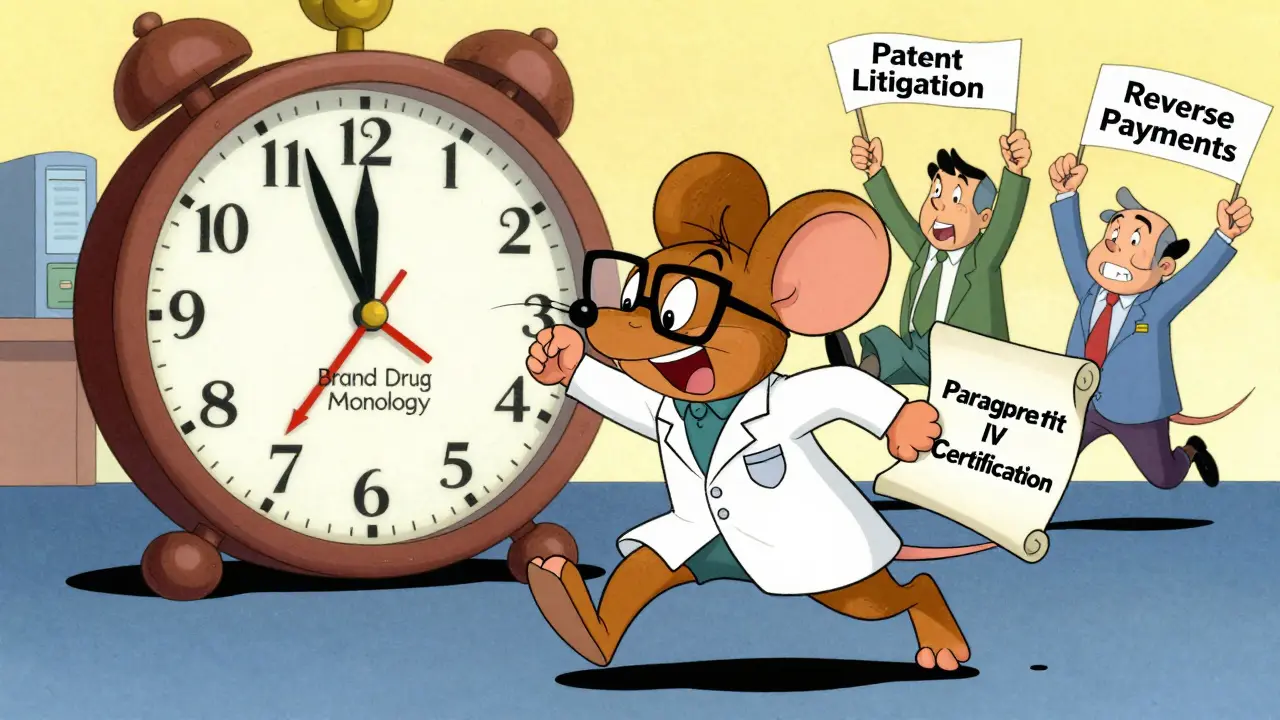
When a brand-name drug’s patent is about to expire, the race to be the first generic company to file for approval can mean hundreds of millions-or even billions-of dollars in profit. But why does the first generic filer get 180 days of exclusive market access while everyone else waits? It’s not luck. It’s not a loophole. It’s a deliberate policy built into U.S. drug law to shake up a market that once made generics nearly impossible to launch.
Back in 1984, Congress passed the Hatch-Waxman Act to fix a broken system. Before then, brand drug companies could stretch their monopolies for years by filing new patents on minor changes-like switching from a tablet to a capsule-just before the original patent expired. Generic companies had no clear path to enter the market. The Hatch-Waxman Amendments changed that. They created a faster, cheaper way for generics to get approved: the Abbreviated New Drug Application, or ANDA. But to get generics to actually challenge patents, lawmakers needed to offer something powerful. That’s where the 180-day exclusivity came in.
What Exactly Is the 180-Day Exclusivity?
The 180-day exclusivity isn’t a reward for being first to market. It’s a reward for being the first to challenge a patent. Here’s how it works: When a generic company files an ANDA, they must check the FDA’s list of patents for the brand drug. If they believe one of those patents is invalid, unenforceable, or won’t be infringed, they file what’s called a Paragraph IV certification. This is a legal shot across the bow. It says: "We’re going to make this drug, and we’re ready to fight you in court."
If you’re the first to file that Paragraph IV certification-and your application is complete-you lock in 180 days of exclusive rights to sell your generic version. During that time, the FDA can’t approve any other generic versions of the same drug, even if they’re just as safe and effective. That means you’re the only game in town. And in a market where 90% of prescriptions are filled with generics, being the only one selling a drug for half a year is a massive advantage.
Why Does This Incentive Exist?
Generic drugs cost far less than brand-name drugs. In 2023, generics made up 90% of all prescriptions in the U.S., but only 22% of total drug spending. That’s a huge savings for patients and insurers. But getting a generic approved isn’t easy. The brand company holds dozens of patents. Fighting them in court can cost $5 million to $10 million-and take years. Most small companies can’t afford it.
The 180-day exclusivity is the carrot that makes it worth the risk. The first filer doesn’t just get to sell their drug. They get to sell it without competition. That lets them charge a price that’s still lower than the brand drug but high enough to cover legal costs and make a profit. Studies show that during those 180 days, the first generic often captures 70-80% of the entire market. In some cases, like Teva’s generic version of Copaxone in 2015, that window brought in over $1.2 billion in sales.
Without this incentive, very few generics would challenge patents. The system would grind to a halt. And patients would keep paying high prices.
How Does the Clock Start?
This is where things get messy. The 180-day clock doesn’t always start when the FDA approves the drug. It can start earlier-when a court rules the patent is invalid or not infringed. Or it can start later-when the company actually starts selling the drug.
The FDA’s official rule says the clock starts on whichever comes first: the date the generic company begins selling the drug, or the date a court decides the patent is invalid. This creates a strange loophole. Some companies file a Paragraph IV challenge, win a court ruling, and then sit on the approval for months or even years-never launching the drug. Why? Because while they’re sitting, no one else can enter the market. The brand drug stays protected. And the first filer holds all the power.
This is called a "paper generic"-a company that gets exclusivity but never sells anything. Since 2010, about 45% of Paragraph IV filings have ended this way. In some cases, the brand company even pays the generic to delay launch. One former executive anonymously told Reddit they paid a first filer $50 million to hold off for 18 months. That’s cheaper than losing 100% of your market overnight.
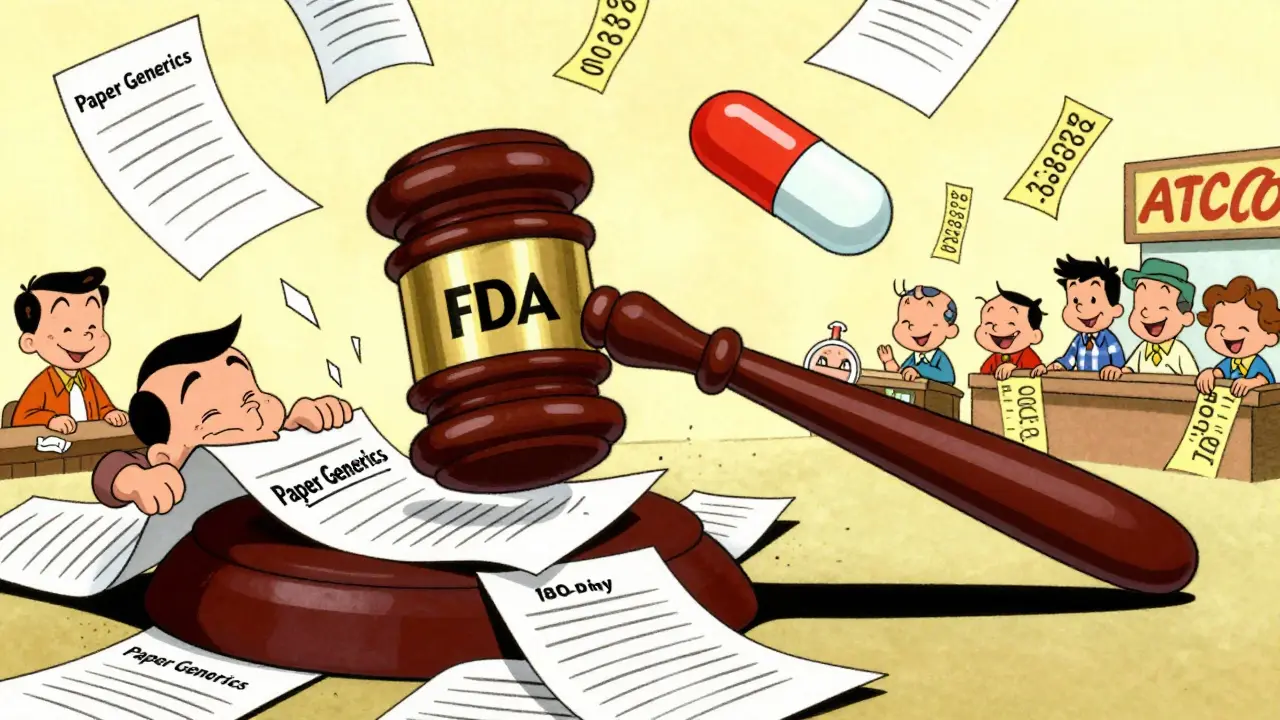
The Problem With the Current System
The original intent of Hatch-Waxman was to get cheaper drugs to patients faster. But the 180-day exclusivity has become a tool for delay. The FDA itself admitted in 2022 that the system has been "manipulated in ways that delay generic competition rather than accelerate it."
When a first filer delays, the brand drug stays the only option for months or years. Patients pay more. Pharmacies can’t switch. Insurance companies get stuck with higher costs. The public health goal of Hatch-Waxman is undermined.
The FDA tried to fix this in 2022 with a proposal: Make the clock start only when the drug actually hits the market. No more "paper generics." No more court wins that don’t lead to sales. But the pharmaceutical industry is fighting back. PhRMA argues that changing the rule would hurt innovation. They say companies won’t risk the lawsuit if they can’t count on exclusivity.
What’s Changing? The Rise of CGT Exclusivity
There’s a new player in town: Competitive Generic Therapy (CGT) exclusivity. Created in 2017, CGT gives 180 days of exclusivity-but only if the drug is one with little or no competition. And crucially, the clock starts when the drug is actually sold. No court wins. No delays. Just real market entry.
CGT doesn’t require a patent challenge. It doesn’t require litigation. It just requires proving that the drug is hard to get. The FDA has already approved 78 CGT drugs since 2022. This is the future. It’s simpler, fairer, and harder to game.
While Paragraph IV exclusivity still dominates, CGT is growing. And it’s the model the FDA is pushing toward.
Who Benefits-and Who Loses?
Big generic companies like Teva, Sandoz, and Viatris dominate Paragraph IV filings. They have the lawyers, the money, and the teams to navigate the legal maze. Small companies? They struggle. Only 15% of small firms even use the FDA’s free guidance services because the process is too complex.
Patients lose when exclusivity is delayed. A 2010 FTC study found that reverse payment deals-where brand companies pay generics to delay-cost consumers $3.5 billion a year. That’s money that could’ve gone to lower drug prices, better insurance, or more treatments.
But patients win when the first filer actually launches. When a generic hits the market, prices drop by 80-90% within months. That’s why the system works-when it works.
The Bottom Line
The 180-day exclusivity rule was meant to speed up access to affordable drugs. And for decades, it did. But as the system became more complex, it became easier to abuse. The first filer isn’t just the first to file-they’re the first to play a high-stakes game of legal poker. And too often, the house wins.
The real question isn’t why the first filer gets 180 days. It’s whether those 180 days should be tied to actual market entry, not legal technicalities. The FDA thinks so. Congress is watching. And patients are waiting.
Can a generic company lose its 180-day exclusivity?
Yes. Under the Medicare Modernization Act of 2003, the FDA can strip exclusivity if the first filer doesn’t market the drug within 75 days of approval, or if they enter into a "reverse payment" settlement with the brand company. Other forfeitures include failing to submit a complete application, withdrawing the Paragraph IV certification, or failing to defend the patent challenge in court.
Do other countries have a similar 180-day exclusivity rule?
No. The U.S. is unique in offering 180 days of market exclusivity to the first generic filer. Most other countries, including Canada, the UK, and Australia, rely on patent expiration and market competition alone. They don’t give exclusivity to the first applicant. This makes the U.S. system an outlier-and a target for reform.
What happens if multiple companies file on the same day?
If two or more companies file their ANDAs with Paragraph IV certifications on the exact same day, they share the 180-day exclusivity. The FDA will approve all of them, and they’ll all get the same exclusivity period. This is why some companies now race to file at midnight on the day a patent expires-sometimes even using automated systems to submit applications the second the system opens.
How long does it take to prepare a Paragraph IV filing?
Preparing a strong Paragraph IV challenge typically takes 18 to 24 months. It requires deep patent analysis, legal strategy, and often, pre-filing litigation threats. Companies must also build manufacturing capacity and secure supply chains before filing. The average investment is $5 million to $10 million, and 37% of filings are rejected for technical errors on the first try.
Is the 180-day exclusivity still valuable today?
Absolutely-but only if the drug is high-value. For blockbuster drugs with annual sales over $1 billion, the exclusivity window can generate $500 million to $2 billion in revenue. For low-cost drugs, the legal costs often outweigh the reward. That’s why most Paragraph IV challenges target high-revenue drugs like insulin, statins, and biologics. The value isn’t in the exclusivity itself-it’s in the price premium you can charge during those 180 days.
 How to Buy Cheap Generic Synthroid Online - A Safe, Fast Guide
 Top 10 Alternatives to Canada Pharmacy Store in 2025
 Opioids and MAOIs: Why This Combination is Dangerous and How to Avoid It
 Why American Mistletoe is the Perfect Addition to Your Daily Supplement Routine
 How to Use Blister Packs and Pill Organizers to Prevent Medication Mistakes
Ernie Simsek
February 12, 2026 AT 22:21Joanne Tan
February 14, 2026 AT 15:44Reggie McIntyre
February 14, 2026 AT 16:04Carla McKinney
February 16, 2026 AT 11:01Jason Pascoe
February 17, 2026 AT 23:20Annie Joyce
February 18, 2026 AT 10:28Rob Turner
February 19, 2026 AT 10:09alex clo
February 20, 2026 AT 07:27Alyssa Williams
February 21, 2026 AT 03:06athmaja biju
February 23, 2026 AT 02:02Robert Petersen
February 24, 2026 AT 08:09