
When your immune system turns against your own blood vessels, things go wrong fast. Vasculitis isn’t just a rash or a sore joint-it’s your body attacking the very pathways that carry oxygen and nutrients to your organs. This isn’t a one-size-fits-all condition. It’s a group of rare but serious autoimmune disorders where inflammation tears through arteries and capillaries, sometimes silently, sometimes violently. Left unchecked, it can block blood flow to your kidneys, lungs, brain, or skin-leading to tissue death, aneurysms, or organ failure.
How Vasculitis Starts: The Immune System’s Mistake
Your immune system is designed to protect you. It recognizes invaders like bacteria and viruses and destroys them. But in vasculitis, something goes haywire. It starts seeing your blood vessel walls as foreign. White blood cells swarm in, releasing chemicals that inflame, weaken, and damage the vessel lining. The result? Narrowed vessels, clots, ruptures, or bulges called aneurysms.
This isn’t random. It’s autoimmune. And it doesn’t pick who it targets. It can strike anyone, but certain types favor specific age groups. Giant cell arteritis, for example, almost always affects people over 50. Kawasaki disease, on the other hand, mostly hits kids under five. The trigger? No one knows for sure. Genetics, infections, or environmental factors may play a role-but the immune system is the real culprit.
Types of Vasculitis: Size Matters
Doctors classify vasculitis by the size of the blood vessels it hits. That tells them what organs are at risk and how aggressive the treatment needs to be.
- Large-vessel vasculitis affects the aorta and its biggest branches. Giant cell arteritis attacks the temporal arteries-those near your temples. If untreated, it can cause blindness or stroke. Takayasu arteritis often shows up in younger women and can narrow arteries leading to the arms, brain, or kidneys.
- Medium-vessel vasculitis targets medium-sized arteries. Polyarteritis nodosa hits muscles, nerves, kidneys, and the gut. Kawasaki disease causes fever, swollen lymph nodes, and red eyes in children-and can lead to coronary artery aneurysms in 20-25% of untreated cases.
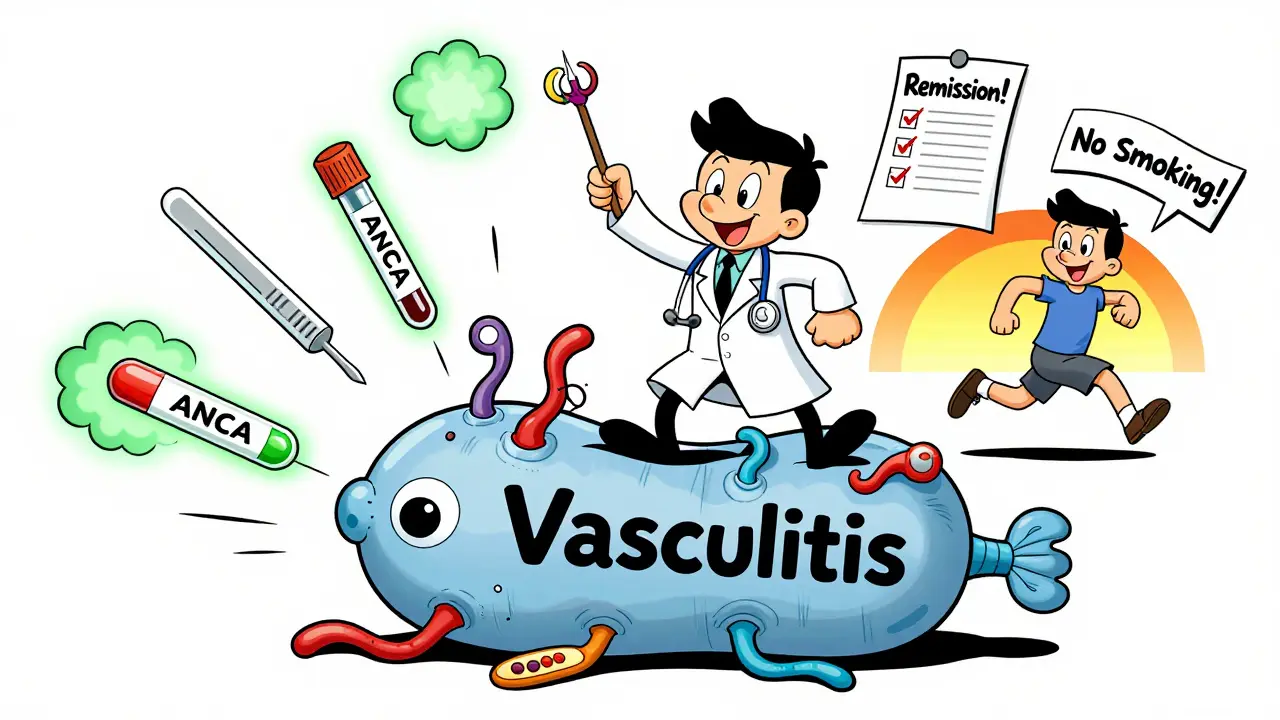
- Small-vessel vasculitis is the most common and dangerous. This includes granulomatosis with polyangiitis (GPA), microscopic polyangiitis (MPA), and eosinophilic granulomatosis with polyangiitis (EGPA). These are often linked to ANCA antibodies-autoantibodies that attack white blood cells and trigger vessel inflammation. MPA loves the kidneys and lungs. GPA can destroy nasal cartilage and cause lung nodules. EGPA comes with asthma and high eosinophil counts.
Then there’s Buerger’s disease, tied directly to smoking. It blocks small arteries and veins in hands and feet. Stop smoking? The disease may halt. Keep smoking? Amputation becomes likely.
What Symptoms to Watch For
Vasculitis doesn’t scream. It whispers. That’s why it’s often missed for months-or even years.
Common signs include:
- Purple or red spots, bumps, or bruises on the skin
- Joint pain or swelling
- Unexplained fever, weight loss, or night sweats
- Numbness, tingling, or weakness in limbs
- Shortness of breath or coughing up blood
- Stomach pain, diarrhea, or bloody stools
- Headaches, jaw pain when chewing (classic for giant cell arteritis)
- Eye redness, pain, or sudden vision loss
Here’s the catch: these symptoms look like the flu, arthritis, or even allergies. That’s why diagnosis is delayed-on average, 6 to 12 months. By then, damage may already be done.

How Doctors Diagnose Vasculitis
No single test confirms vasculitis. It’s a puzzle. Doctors piece it together using:
- Blood tests: ESR and CRP levels spike when inflammation is active. ANCA testing is key-c-ANCA (targeting proteinase-3) is 80-90% specific for GPA.
- Urine tests: Protein or blood in urine means kidneys are involved. This is critical-even if you feel fine.
- Imaging: CT scans, MRIs, or angiograms show narrowed or blocked vessels. PET scans can detect inflammation in large arteries.
- Biopsy: The gold standard. A small sample of affected tissue (skin, kidney, lung, or temporal artery) shows immune cells tearing through vessel walls. Leukocytoclastic vasculitis-nuclear debris around vessels-is a telltale sign in skin biopsies.
The Five Factor Score helps predict outcomes in polyarteritis nodosa. It looks for: kidney failure, gastrointestinal involvement, heart problems, nerve damage, or central nervous system issues. More factors = higher risk of death.
Treatment: Stopping the Attack
The goal? Stop the immune system from attacking-and protect your organs before it’s too late.
For severe cases, treatment starts with high-dose prednisone (0.5-1 mg per kg daily). That’s often combined with cyclophosphamide or rituximab to knock down the immune response. This phase lasts 3-6 months-called induction.
Then comes maintenance: lower doses of methotrexate, azathioprine, or continued rituximab for 18-24 months. The aim? Keep the disease in remission without wrecking your body with steroids.
Recent breakthroughs have changed the game:
- Avacopan (approved by the FDA in 2021) blocks a key inflammation signal (C5a). In the ADVOCATE trial, patients on avacopan had 2,000 mg less cumulative steroid exposure over a year-without losing effectiveness.
- Tocilizumab (an IL-6 inhibitor) is now approved as an add-on for giant cell arteritis. It helps reduce steroid doses and relapses.
- Mepolizumab is showing promise for EGPA, cutting relapse rates by half in early trials.
For Buerger’s disease? There’s no drug that works. Only one thing does: quit smoking. Completely. No exceptions.
Prognosis: Can You Live With It?
With early treatment, 80-90% of people with ANCA-associated vasculitis reach remission. But here’s the hard truth: about half will relapse within five years. That’s why lifelong monitoring is non-negotiable.
Survival rates depend on organ damage. For polyarteritis nodosa:
- No major organ involvement? 95% survive five years.
- One major factor (kidney, heart, gut)? 75%.
- Two or more? Drops to 50%.
Untreated giant cell arteritis can cause permanent blindness. Untreated Kawasaki disease can lead to heart attacks in children. Vasculitis doesn’t wait. It doesn’t ask permission.
Living With Vasculitis
Most people can manage the disease-but it’s not easy. Medications weaken your immune system, so infections are a constant threat. Steroids cause weight gain, bone loss, and mood swings. You’ll need regular blood tests, imaging, and doctor visits.
Patients often report fatigue, joint pain, and anxiety. Support groups, physical therapy, and mental health care are as important as medication. Stay active. Eat well. Avoid smoking and excessive alcohol. And never skip your follow-ups-even if you feel fine.
Research is moving fast. Scientists are studying biomarkers like BAFF and MCP-1 to predict flares before symptoms start. The goal? Personalized treatment. No more guessing. Just precision.
When to See a Doctor
If you have unexplained symptoms lasting more than two weeks-especially if you’re over 50 and have headaches or jaw pain, or you’re a child with persistent fever and red eyes-see a doctor. Ask specifically about vasculitis. Don’t let it be dismissed as "just stress" or "a virus."
A rheumatologist is your best bet. They’re trained to spot these subtle, systemic diseases. Early diagnosis isn’t just helpful-it’s life-saving.
 Compare Atorlip 5 (Atorvastatin) with Alternatives: What Works Best for Cholesterol
 Clotting Disorders and Anticoagulation: Understanding INR, DOACs, and Safety
 Why Acetaminophen Helps with Social Pain: Surprising Research Insights
 Blue Light and Eye Health: Screen Filters and Habits That Actually Work
 Wellbutrin Sr Prescription Online: Comprehensive Guide to Bupropion Treatment
Darren Links
January 22, 2026 AT 14:17Wow, so now the government’s using autoimmune diseases to control the population? I mean, why else would they push all these expensive drugs when the real cause is 5G towers messing with your capillaries? They don’t want you to know that natural remedies like garlic and apple cider vinegar can reverse this. Look at the stats - no one’s talking about it because the pharma lobby owns the FDA. 😈
Kevin Waters
January 23, 2026 AT 22:27This is actually one of the clearest explanations of vasculitis I’ve ever read. I’ve got a cousin who was misdiagnosed for 14 months with "chronic fatigue" before they found GPA - she lost part of her hearing and had a kidney biopsy that nearly broke her. But after rituximab and cutting back on salt? She’s hiking again. Don’t ignore those weird rashes or jaw pain. Early = life-changing.
Kat Peterson
January 25, 2026 AT 11:42OMG I JUST HAD A MOMENT 😭 I’ve had those purple spots on my legs for months and my doctor said "it’s just stress rash"… but now I’m crying in my car because what if it’s MPA?? I’m googling ANCA tests RIGHT NOW. Someone please hold me 🤍🩷🩵
Jamie Hooper
January 26, 2026 AT 15:06bloody hell this is intense. i thought my sore knee was just arthritis but now im paranoid every time i get a bruise. i mean, if your blood vessels are literally being attacked by your own body… what even is safe anymore? 😅
Husain Atther
January 28, 2026 AT 00:07An excellent and comprehensive overview. As someone from India, where access to rheumatologists is limited outside major cities, I appreciate how this breaks down diagnostic pathways and treatment options. The mention of the Five Factor Score is particularly useful for triaging cases in resource-constrained settings. Awareness is the first step toward equity in care.
Helen Leite
January 28, 2026 AT 04:25they’re hiding the truth. it’s not the immune system - it’s the vaccines. i read a blog that said the spike protein sticks to blood vessels like glue. that’s why they don’t want you to know about avacopan - it’s not FDA-approved for real reasons. i know someone who got better after drinking lemon water with cayenne. 🍋🔥
Izzy Hadala
January 29, 2026 AT 18:00While the clinical descriptions are accurate, I would respectfully suggest that the assertion regarding the specificity of c-ANCA for GPA warrants additional nuance. Recent studies (e.g., Hoffmann et al., 2022) indicate that c-ANCA positivity may occur in up to 10% of non-GPA vasculitides and even in certain chronic infections. The diagnostic algorithm must incorporate clinical context, histopathology, and imaging - not serology alone. Precision medicine requires precision in interpretation.
Karen Conlin
January 31, 2026 AT 01:59To everyone panicking about symptoms - breathe. You’re not alone. I’ve been living with EGPA for 8 years. I had asthma, skin lesions, nerve pain - thought I was dying. But I found a rheumatology team that listened. I’m on mepolizumab now. I run marathons again. You don’t need to suffer in silence. Find your specialist. Join a group. Tell your story. This disease doesn’t define you - your courage does. And if you’re reading this and you’re scared? I’ve been there. You’ve got this. 💪❤️