
Bleeding Risk Assessment & Symptom Checker
Check all that apply to evaluate your potential risk profile based on the article data.
Click on any symptom you are currently experiencing to see the recommended action.
Taking medication to prevent blood clots can be a lifesaver, but it comes with a frightening trade-off: your blood simply doesn't clot the way it should. While anticoagulants are designed to stop strokes and heart attacks, they can either cause a slow leak or a sudden, catastrophic hemorrhage. The real danger is that many people don't recognize the signs of internal bleeding until they are dizzy or fainting, often waiting hours before seeking help.
Quick Summary: What You Need to Know
- The Danger Zone: The first 90 days of therapy are the most high-risk for bleeding complications.
- Red Flags: Black, tarry stools, blood in urine, or nosebleeds lasting over 10 minutes require immediate ER attention.
- Risk Factors: Age (especially 80+), kidney issues, and using multiple blood thinners together significantly increase risk.
- Medical Response: Doctors use specific reversal agents like idarucizumab or andexanet alfa to stop severe bleeds.
Why Blood Thinners Cause Severe Bleeding
Blood thinners aren't actually thinning your blood; they are interfering with the chemical process that creates a plug (a clot) when a vessel is damaged. Warfarin, for example, blocks Vitamin K, which the body needs to build clotting factors. Newer drugs, known as Direct Oral Anticoagulants (DOACs)-which include Apixaban, Rivaroxaban, and Dabigatran-target specific proteins in the blood to slow down the clotting time.
The problem is that this mechanism doesn't distinguish between a dangerous clot in your heart and a tiny nick in your stomach lining. This is why a high percentage of patients experience bleeding events. For instance, about 3.1% of patients with atrial fibrillation encounter bleeding within their first year of DOAC use. The most critical complications involve organs like the brain or gastrointestinal tract, where mortality rates can range from 5% to 15% if not treated instantly.
Comparing Bleeding Risks Across Different Medications
Not all blood thinners carry the same risk profile. Depending on your health history, one might be significantly safer than another. For people with a history of stomach issues, some DOACs are better choices than others. Data shows that Apixaban generally carries a 31% lower risk of recurrent GI bleeding compared to Rivaroxaban.
| Medication | Annual Major Bleeding Rate | Key Monitoring Requirement |
|---|---|---|
| Warfarin | ~3.09% - 3.4% | Regular INR blood tests |
| Apixaban | ~2.13% | Renal function assessment |
| Rivaroxaban | ~3.6% | Creatinine clearance (CrCl) |
| Dabigatran | ~3.11% | Kidney function monitoring |
Who Is Most at Risk?
Your risk isn't just about the drug; it's about your body's overall state. The single strongest predictor of a future bleed is whether you've had one before. In fact, a prior major bleeding event increases your risk of another one by over four times.
Age plays a massive role. Research from a Swedish cohort showed that patients over 80 have significantly higher bleeding rates (4.33 per 100 treatment-years) compared to those under 60 (1.25 per 100 treatment-years). Kidney health is another critical factor. Because many DOACs are cleared through the kidneys, renal insufficiency can cause the drug to build up in your system, increasing your bleeding risk by 2.3 times.
Finally, "stacking" medications is dangerous. If you are taking a blood thinner along with an antiplatelet drug like Clopidogrel, you essentially double your risk of a severe hemorrhage. This is a common scenario for patients who have recently had a stent placed in their heart but also have atrial fibrillation.
Spotting a Crisis: Warning Signs and Symptoms
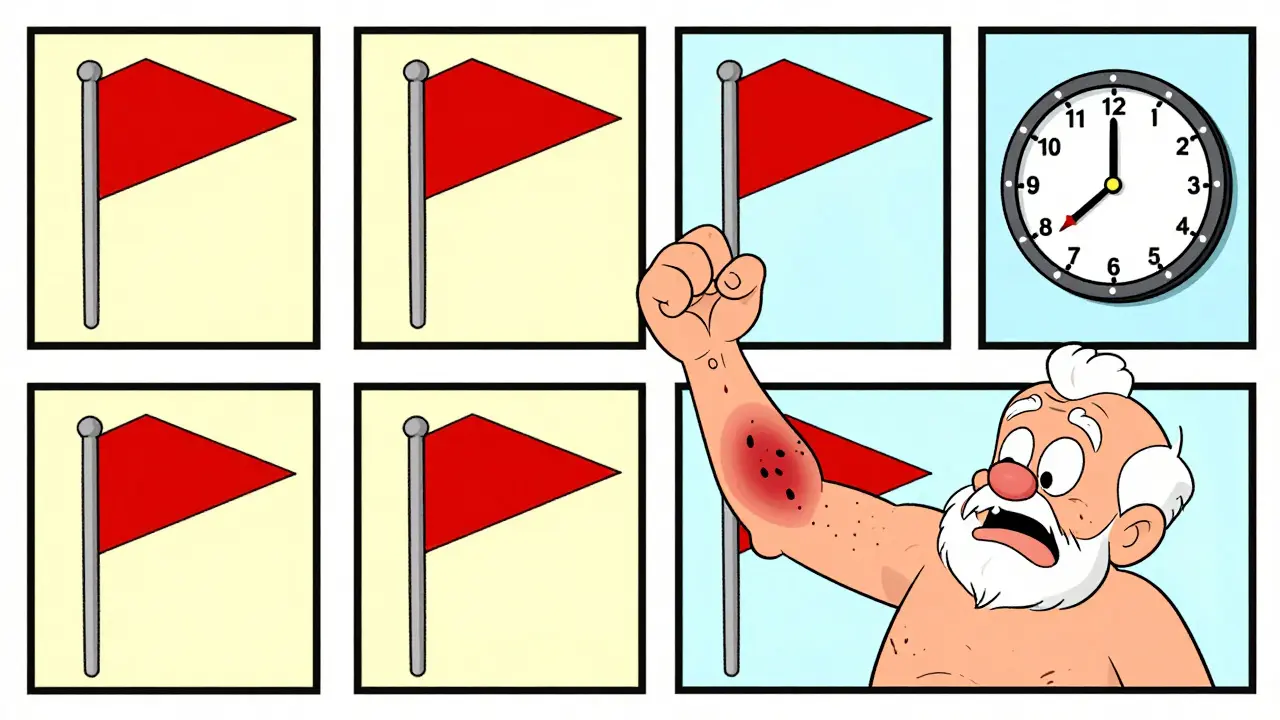
The most dangerous part of a bleeding episode is the "silent" phase. Many patients report seeing black, tarry stools (a sign of a stomach bleed) for several days before realizing it's an emergency. Some describe nosebleeds that last 45 minutes, which they ignore until they feel dizzy from blood loss. You cannot afford to "wait and see" when you are on anticoagulants.
You should head to the Emergency Room immediately if you experience any of these 12 red flags:
- Nosebleeds that won't stop after 10 minutes of pressure.
- Blood in your urine (appearing red or brown).
- Stools that look like black tar or coffee grounds.
- Unexplained, large bruises (hematomas) appearing without a hit.
- Coughing up blood or vomiting blood.
- A sudden, severe headache (could signal a brain bleed).
- Feeling faint, dizzy, or unusually weak.
- Sudden changes in your vision.
- Menstrual bleeding that is much heavier than normal.
- Joints that swell or hurt intensely after a minor bump.
- Small cuts that continue to bleed despite pressure.
- Pale skin combined with shortness of breath.
Emergency Response: What Happens at the Hospital?
Once you arrive at the hospital, the goal is to stop the bleed and "reverse" the medication. This isn't as simple as just stopping the pill; the drug is already in your bloodstream and needs to be neutralized.
Depending on your medication, doctors use specific reversal agents. For Dabigatran, they use a drug called idarucizumab. For factor Xa inhibitors like Rivaroxaban or Apixaban, they may use andexanet alfa. These are highly specialized and expensive treatments that act like an "off switch" for the blood thinner.
In addition to reversal agents, the medical team will likely:
- Perform a hemoglobin test to see how much blood you've lost.
- Administer blood transfusions if your hemoglobin has dropped significantly (usually defined as a drop of >5 g/dL in severe cases).
- Use endoscopic procedures to find and cauterize a bleeding ulcer in the stomach.
- Conduct CT scans if a brain hemorrhage is suspected.

Preventing Future Episodes
If you've had a bleed, the focus shifts to precision dosing. We are entering an era where doctors can measure the actual level of the drug in your blood rather than just guessing based on your weight or age. New point-of-care tests now allow clinics to check DOAC levels quickly, which is vital for patients over 75 or those with kidney problems.
A simple but effective strategy is the "Safety Checklist" approach. Spend time with your doctor reviewing your HAS-BLED score-a tool used to predict your bleeding risk. If your score is 3 or higher, you need a more aggressive safety plan, which might include more frequent kidney function tests or a change in medication dosage.
What is the most dangerous time to be on blood thinners?
The first 90 days after starting anticoagulation are the most critical. This is when the body is adjusting and when supratherapeutic drug levels are most likely to occur, leading to a higher frequency of bleeding events.
Is a nosebleed always an emergency on blood thinners?
Not every nosebleed is a crisis, but any bleed that lasts longer than 10 minutes despite applying firm pressure is a serious warning sign and requires immediate medical attention.
Can I take aspirin while on a DOAC?
Combining antiplatelets (like aspirin or clopidogrel) with anticoagulants can double your bleeding risk. You should only do this under strict medical supervision if the benefit of preventing a heart attack outweighs the risk of a hemorrhage.
How do doctors determine the right dose for someone with kidney disease?
Doctors use Creatinine Clearance (CrCl) tests. For example, with Rivaroxaban, a patient with a CrCl over 50 mL/min might take 20 mg, while someone with a clearance between 15-50 mL/min would be dropped to 15 mg to prevent drug buildup.
What are reversal agents?
Reversal agents are medications designed to neutralize the effect of blood thinners quickly. Examples include idarucizumab for Dabigatran and andexanet alfa for Factor Xa inhibitors, used primarily in life-threatening bleeding scenarios.
Next Steps and Troubleshooting
For New Patients: Ask your doctor for a written list of the 12 critical symptoms. Don't rely on memory. If you have a high HAS-BLED score, request a more frequent monitoring schedule for your kidney function.
For Caregivers: Watch for subtle changes in the patient. If an elderly patient suddenly becomes confused, sleepy, or develops a severe headache, assume it is a medical emergency until proven otherwise, as these can be signs of internal bleeding.
For Those with Prior Bleeds: Discuss "bleeding-safety" alternatives with your hematologist. New candidates like milvexian are being studied for their ability to prevent clots while reducing the risk of hemorrhage by 20-25% compared to current standard drugs.
 Buy Cheap Generic Atenolol Online - Safe Tips & Best Prices
 Buy Cheap Generic Amoxicillin Online - Australian Guide 2025
 Why Generic Drug Prices Vary So Much Between States
 Zithromax Alternatives: 8 Options Explained For Real-Life Treatment Choices